Note: The Hindi translation of this obituary can be also be read by clicking HERE.
 With the demise of Kashi Ram, India has lost its strongest hope of having ‘a Dalit Prime Minister.’ I remember visiting him with my father at Delhi’s Ganga Ram Hospital almost three years ago: typically, he spoke with his eyes, at once vacant and watery. When we got up to go, he tugged at my hand, asked me to come closer, and whispered into my ear: “tumko ladna hai” (you’ve to fight).
 Uncle Tom’s Savior
Mr. Ram’s followers claim for him the mantle of our nation’s most celebrated Dalit icon credited as ‘the father of India’s Constitution’, Babasaheb Bhimrao Ambedkar. It is a comparison that he might not have wholly agreed with: no doubt, he was publicly unabashed in his devotion to the Cult of Babasaheb, even to the extent of raising it to a form of religion; yet this devotion wasn’t blind. His true greatness, in my opinion, lies in his ability to identify his Hero’s principal shortcoming: put simply, unlike Mahatma Gandhi who emerged as ‘the Sole Spokesman’- to adapt Ayesha Jalal’s evocative phrase for Mohammed Ali Jinnah- of the Indian National Congress, Babasaheb was a Leader without the backings of an Organization, which could take his message to every part of India. Mr. Ram spent the last four decades of his life doing his best to remedy this.
My father remembers him coming to Shahdol in the mid-1970s: at the end of his week-long tour of the remote Baghelkhandi district, whose politics is even today dominated by an endless and often ruthless struggle between Thakurs and Brahmins, he had run out of money to pay for his third-class railway fare to wherever he had planned on going next. What he did next reveals a lot about how he almost single-handedly gave birth to the Dalit Movement of India: at the break of dawn, he was at the Collector’s Bungalow, demanding- no, commanding- that its tribal occupant- my father- get him his ticket. The question isn’t so much about whether my father obliged (to set the record straight, he did) but much more significantly, why?
I found the answer as a post-graduate student at JNU while attending a late-night meeting of the United Dalit Students’ Forum (UDSF) along with the current head of the Indian Youth Congress. The speakers were African Americans delegates of the NAACP, come all the way from the United States of America, perhaps in quest of Solidarity with their Indian counterparts. They warned us about the pitfalls of becoming ‘Uncle Toms’, who are the most common- and in their opinion, ill-fated- products of Affirmative Action (or what is more commonly known in India as ‘Reservations’). In essence, an ‘Uncle Tom’ refers to persons who have risen up the socio-economic ladder riding on Reservations but rather than actively assist other members of their community, they spend more time and effort in trying to gain acceptance of the ‘elite’; or worse, begin to live in self-denial, by erasing from their memories, the shared history of oppression. Thanks to Mr. Ram’s persistent efforts, a lot of well-meaning, well-to-do Indian Dalits were offered a discreet avenue- the All India Scheduled Castes and Schedules Tribes Government Employees Association- to help their kind, and thereby saved the ignominy- that corrosive guilt and shame- of becoming treacherous Uncle Toms.
March of the Blue Elephant
How did this one man’s journey to battle an ancient and seemingly unbeatable enemy- the caste system- begin? Despite what the mythology-makers would like to make of it, the fact is that Mr. Ram did not experience caste-based oppression, none that he could recall anyway, during his childhood days in the Punjab: historically, the Bhakti movement led by Guru Nanak and its off-shoot, Sikhism, had played the role of the great leveler in the land of the five rivers, by offering those oppressed by Brahminical homo hierarchichus- to use Louis Dumont’s phrase- a way out. In fact, it wasn’t until one fine afternoon at Poona while playing tennis with his co-officers did he realize just how deep the caste fault-lines ran in this country: not knowing that the fair-skinned Mr. Ram was a Dalit, his partner refused to drink lemonade for the sole reason that the Dalit ‘chaprasi’ had committed the awful mistake of actually letting his ‘untouchable’ hand touch the glass.
The time had come for Mr. Ram’s epiphany: overcome with what can only be described as an overwhelming sense of ‘Paternalism’, he decided at that very instance that whatever remained of his life, would be devoted to destroying these man-made, socially-constructed fault-lines. Needless to say, such an enterprise called for extreme personal sacrifices, comparable with the Mahatma’s: he resigned the quiet comforts of his government job; severed all links with his family; never married; not once held public office (his detractors will be quick to add that this was less out of choice and more due to circumstances); and went about the business of ‘inventing’ a new all-embracing family of Dalits from all over India. It is precisely the way he ‘invented’- by politicizing, for better and for worse- the New Dalit Identity, which marks him apart from every other Dalit leader, including Babasaheb, of India’s arduous history. For much of his life, Mr. Ram remained the quintessential shadow moving all over India’s vast hinterland, silently inflaming its millions of Dalits into seizing power by democratic means.
The idea was always there: some seven decades ago, Babasaheb himself had enunciated it when he demanded- and almost got- separate ‘electorates’ reserved for the Dalits under the provisions of the GOI Act (1935) despite the Mahatma’s fast-unto-death opposition against it. Both leaders, now pitted against each other, had their respective points of view: Mr. Ambedkar held true to his belief that ‘politics is the surest way to bring about social change’; Mr. Gandhi saw hidden ‘divide (the Hindu community) and rule (India)’ designs behind the move. The genius of Kashi Ram lies in the fact that he combined both viewpoints. For him, it was less an issue of ideology and more a matter of mathematics: he believed that Dalits, by virtue of their sheer numbers, were destined to preside over India’s democracy. The only question was how to bring them together on a common platform?
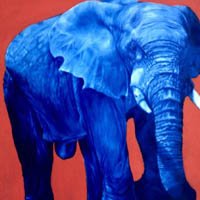
This is where people like my father differ from him: for them, it is more important for Dalits to capture power within established political parties. Not so for Mr. Ram: sharing Babasaheb’s chronic distrust for preexisting national parties, he labored to create a wholly distinct Dalit pan-Indian political alternative manifested in the chequered career of the Bahujan Samaj Party (BSP) painstakingly built on discreet donations from would-have-been Uncle Toms to aid cadres of tireless full-timers in constantly egging the seemingly unstoppable “March of the Blue Elephant” (the BSP’s election-symbol).
In doing so, Mr. Ram willfully opened what the nationalists’ Pandora’s Box: almost suddenly, Caste became the principal, if not the sole, criterion in the determination of electoral outcomes, especially in the cow-belt. Ideology- for that matter, even ideas- took a backseat to the mechanics of seizing power by whatever means- and compromises- necessary. Mirroring Karl Marx’s erroneous deterministic-prescription of an ‘alliance with the bourgeoisie’- sadly for him, the continental Revolts of 1840 proved decisively that the ‘middle-classes’ would much rather ally with the Ancien Regime rather than the emergent proletariat- Mr. Ram, and his protégé, Mayawati, did not shy away from allying with their natural ideological opponents, whose entire politics rests on the cardinal belief that ‘Hindu is not an organization within society but instead an Organization of Society’ [Golwalkar, We or Our Nationhood Defined], in the somewhat hasty quest for power. At a certain level, the short-lived BSP-BJP alliance in Uttar Pradesh heralded the beginning of Dalit disenchantment with the ideology-less, power-centric politics espoused by the BSP. This, however, was the least of its problems.
The Ambiguous Mathematician
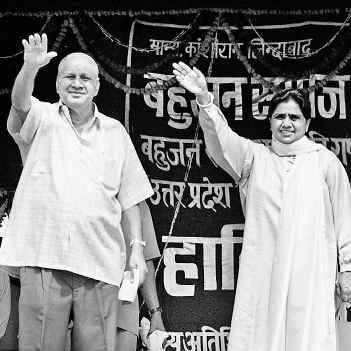
The Path to Power isn’t always as easy as it looks, more so in an onion-shaped polity like ours, where the peeling-open of each successive layer reveals an increasingly acidic multiplicity of identities, of which caste- the shared experience of systematic oppressions- is only one. Mr. Ram clearly failed to factor-in the sordid business of religion- that intoxicating ‘opium of the masses’- in his mathematical equations. By consolidating the Dalit votebank for the BSP, he was, unwittingly perhaps, eroding the Congress- or, if one prefers, the Secular- base. Put mathematically, the rise of the BSP was in direct proportion to (a) the decline of the Congress and (b) the rise of the BJP, which emerged as its direct contestant. In a riveting study of the Babri Masjid demolition, a group of historians led by Tanika Sarkar discovered that a majority of the kar-sevaks belonged to the ‘Valmiki’ community (the BJP’s term for Dalits). Indeed, the BJP-penetration in tribal and scheduled-caste constituencies has been remarkable for chiefly two reasons: one, the intensification of indoctrination work being carried out by RSS-affiliates such as the Vanvasi Kalyan Ashrams, Saraswati Shishu Mandirs, Ekal Vidyalayas et al; and two, the division of these votebanks between the two ‘secular’ rivals vis-à-vis the Congress and the BSP.
This latter phenomenon is not restricted to Dalit and tribal regions. In a meeting with the industrialist Mukesh Ambani prior to the post-Godhra Gujarat election, he pointed out that the biggest hurdle to the Congress comeback was the ‘TINOU factor’, which is a quaint acronym for the phrase ‘There Is No Opposition Unity’: more specifically, this referred to the rather sorry state of affairs wherein all of the so-called Secular parties vis-à-vis Congress, SP, NCP and the BSP, were contesting separately in almost all the seats of the state, thereby splintering the anti-communal (read: anti-BJP) votebank, and paving the way for the Narendra Modi-comeback. Not surprisingly, the biggest anti-climax for the secular forces- especially the Congress- was the total wipeout in the predominantly tribal North Gujarat. In any event, two important lessons were learnt from the Gujarat debacle: first, the Congress top brass convened at Simla to affect a major volte-face of its previous Panchmarhi Declaration, and resolved to actively play a leadership role in the consolidation of the Secular Alliance within the broader framework of coalitional politics (one might even say that the seeds of the UPA Victory were planted here); and secondly, the middle-of-the-road approach, reflected in ‘the soft Hindutva’ approach adopted during the Gujarat campaign, was abandoned once and for all.
These cataclysmic changes in the contours of Indian polity called for a strategic realignment- ‘reinvention’- of Mr. Ram’s party- and India’s Dalit Movement- all over again. Would the BSP as the main exponent of majority-casteism, categorically distance itself from the forces of majority-communalism? Would it ally itself with the secular alliance? If so, would it accept the leadership role self-assigned to the Congress? And of course, the biggest question of them all: could the hurdle of irrevocably ruptured, increasingly personalized and bitter Uttar Pradesh Politics ever be surmounted to bring together the three big ‘secular’ parties- the BSP, SP and the Congress- on a national level?
There was just one catch: it was apprehended amidst a much-publicized volley of allegations and counter-allegations that the architect of India’s Dalit Movement was nothing more than a puppet in the hands of his protégé, Ms. Mayawati. Even if that were true, it’s difficult to imagine how things might have turned out differently. Still, the Hope that Mr. Ram’s acute sense of History as indeed his unsurpassable experience as the fountainhead of a radical, politicized Dalit identity, would have imparted much-needed clarity in setting the future course of the BSP and the Dalit Movement. In any event, it would be safe to say that he no longer held the reins of power, even within his own party: successive electoral defeats from his homeland Punjab (where, as has been pointed out earlier, the impact of the Dalit-issue remains minimal); fledgling health; and Ms. Mayawati’s increasingly aggressive desire to emerge from his over-looming shadow and carve her own niche, all conjoined to ensure that Mr. Ram’s voice- if at all heard- was merely a distant echo, amplified through the hoarse textures of his anointed successor’s constantly shifting, ambiguous acoustics.
It will be some time yet before Kashi Ram’s legacy can be deciphered. All that can be said for certain is that with him and in him and through him, the idea of a Dalit Prime Minister- irrespective of the individual who sits on the Throne- has gained a hitherto absent, if only arithmetical, legitimacy: this perhaps is to be his greatest ‘ideological’ contribution.
AJ
Read More (आगे और पढ़ें)......

