Showing posts with label travelogue. Show all posts

Monday, July 30, 2007

Village Diary Preview: Pictures from Tala

Note: I am grateful to Mr. SNT, Mr. Anuj Sharma and Mr. Ardhendu Mukherjee for the following photographs from their one-day visit to see me at Tala; Dr. Saibel Farishta has written his account of the trip, which can be read on his blog.


L-R: SNT, Saibel, Self, Ardhendu at the entrance to the Garba Grha of the Devrani Temple, 29.07.07
*


Rudra Siva as seen by Ardhendu Mukherjee, 29.07.07
*


A Room with a View: A Donga on the Maniyari
*


Self aboard the Donga (also seen: the MLA Mr. Siyaram Kaushik's back, Gopal Aggrawal and the village sarpanch's back)
*


Tour Guide: Self explaining the intricacies of an early Haihaya sculptor to the Chhattisgarhi superhero, Anuj Sharma (seen here in his underpants) and the BAG correspondent, Ardhendu Mukherjee
*


Read More (आगे और पढ़ें)......

Saturday, June 30, 2007

Voices from Tala: Village Diary Preview

Recently, the IANS/Reuters correspondent for Chhattisgarh, Mr. Sujith Kumar, wrote a piece on my stay at Tala, entitled, 'Amit Jogi Toils With Tribals, for Career's Sake', which was carried by a variety of newspapers (22.07.07). On the whole, it offers a somewhat different perspective of things, projecting a motive where none in fact exists.

Note: I am in Raipur tonight to attend Mr. Chaveendra Karma's wedding reception, and will return to Tala tomorrow morning. Presented below are excerpts from my Village Diary. Before I part, I would like to share with the Reader the following hana (folk-saying):

Char godh ké Chappo (Four-footed Chappo)
Tekhar upar Nippo (Above, Nippo)
Aa gayé Gappo (Came Gappo)
Lé gayé Nippo (Took Nippo)
Baacché Chappo Chappo (Remains only Chappo Chappo)


The above hana makes so much more sense once we know that 'Chappo' stands for Mother Earth; 'Nippo' refers to Mankind; and 'Gappo' is Death. Makes one think, doesn't it?


AJ


June 21-22, 2007
Mr. Kuber Yadu, a longtime family associate handpicked by Papa & SNT principally due to his incontrovertible ‘Chhattisgarhi’ credentials, accompanies me to Tala; enroute, we halt at his village, Marrakona on the banks of the river Seonath. At Mr. Yadu’s farm, I am given a crash course in the three kinds of sowing prevalent in the region: khurra (dry-sowing, before rainfall); batar (after rainfall); and ropa (wet-sowing, i.e., transplanting of saplings raised in a nursery, tharra). He insists on my paying obeisance to the local deity, Mawli Mata.


After crossing the river Maniyari, a tributary of the Seonath, we arrive at our destination, Tala (aka Ameri-Kapa). Well, not Tala per sé. My host, Mr. Siyaram Kaushik, who is also the local MLA, has lodged me in one of the rooms of a newly constructed temple-complex adjacent to the historic- and only one of its kind- statue of Rudra-Siva (more about this later; photo above). To my disappointment, he has had a rather noisy water cooler fitted in it. Happily though, for ablutions I must, like the rest of the village folk, rely on the Great Wide Open. Or, as the locals refer to it: bahi-dahar (literally: out of the way, or outskirt). It is well past midnight by the time dinner is cooked: it comprises a simple but fulfilling meal of rice, dal and beans (sémee) with a relish of raw onions.

My desire to sleep outside is summarily dismissed citing snakes: the ghodi-karayat variety, which is small, jet-black and deadly poisonous, is more fearsome than the asadhiya, which is long, fair and has the cumulative effect of a shot of marijuana (weed). Mr. Yadu fondly recollects that this reptilian analogy was used by his late father, the freedom fighter Mr. Parasram Yadu, to compare my father with his rival, Vidya Charan Shukla.

I wake up at 5:30 a.m. Bravely, I venture out into the unknown for my morning ablutions; with a little help from Mr. Yadu, I find a nice little spot to defecate. Unfortunately, despite my best efforts, I remain constipated for the rest of the day. After a quick bath at the local bored-well, right in the front of the historic Siva statue, we head off to the nearby fields: here, I try my hand at the Nagar, the neolithic plough still in vogue. It is pulled by two bullocks: to make a right-turn, shout Arra to the bull on the right; for left, it’s Tatta to the bull on the left; and to stop, Ho-ho. If they don’t obey, simply use the stick (tutari). For a first-timer, I do OK.


I also learn a little bit about how farmland is divided. Apparently, the revenue department has got it all wrong. Instead of the patwari’s maps (khasra), villagers prefer to follow the rule of the incline (slope): water flows downwards from the pakhar to the ghansa; accordingly, the field on the side of pakhar (upland) is called pakhar-bhata; likewise for ghansa. The problem, really, pertains to ownership of the raised piece of land that separates the fields, called med. According to the law, all owners have equitable rights over the med. This is easier said than done, and quite naturally, becomes a major cause of disputes: who, for instance, owns the mango tree growing on the med? Now, according to the custom of chanda-munara, each farmer has rights to two of the four meds, one of pakhar and the other of ghansa. This example illustrates the precedence custom- or common law- has over formalistic (land revenue) regulations.

In the evening, we take a bullockcart (bailagadi) ride to the village to participate in the evening ritual called ‘gudi ke goth’ (literally, talks of the village square). The commands Arr-Tatta-Hoho apply equally to the Nagar as well as the bailagadi. At the gudi, where I sit cross-legged on the ground with the rest of the village folk, the entire atmosphere is marked by a refreshing frankness: more than the men, it’s the women who do the talking. The politest way of starting a conversation is to ask: “ka saag rangath has?” (what’s cooking?) Soon, I am in the midst of a culinary class. The staple, basi, or left-over rice from last night soaked in water, is also the favorite: it tastes absolutely marvelous with a jojo (fried-chutney) of tomato, red-chillies or (as Papa likes it) garlic, a bhaaji (sautéed green leafy vegetable) and some curd. As a rule, womenfolk are expected to carry a batki of basi on their heads along with these condiments to the menfolk, who are working hard at their fields, at precisely twelve ’o clock. This hour of midday rest is called thad ki béra (ironically, thad means to stand upright, no doubt an allusion to the sun's perpendicular position).

The womenfolk, comprising all castes, gather around the choura (sacred platform), to dance to the Sua. From the lyrics, it appears that Suas are intensely religious songs, not very different in content from the monastic evensong:

Ayodhya mein Ram khélé hori (Ram plays holi in Ayodhya)
Mati mangalé, Choura bandhalé (Get the mud, Build the Choura)
Ayodhya mein Ram...
Chaanti bechara dohara mati (Even the poor ants bring mud)
Ayodhya mein Ram...
Jahan bajé nagada dason jodi (Where drums resound is ten-pairs)
Ayodhya mein Ram...

As we walk back to the temple-complex, a distance of a kilometer and a half, we stop at a house. Here, we are given a demonstration of three household implements found in almost every village home, by the family’s venerable ‘mayaru bhouji’ (beloved eldest sister-in-law): the jata (used for grinding flour); the déki with its iron-pounder called musar (used to dehusk paddy); and the konéta jata (mud grinder used for dehusking the relatively softer kodo, an excellent diabetic-substitute for rice). There is also the gorsi, an earthen vessel in which cowdung cakes are burnt, to roast rotis, or simply to keep warm during winters. All these implements are made at home by the ladies. On the road, we are crossed by the dreaded ghodi-karat. As with every other omen, this is interpreted as a sign of good luck.

Tomorrow, we intend going fishing with the Kevats & Dhevars. The prospective catch, comprising of Tengna and Kokhiya, promises to be appetizing. Naturally, I am rather looking forward to it.

June 23, 2007
It’s almost four p.m., and there’s no sign of the boatman: the geriatric sarpanch, it appears, has bungled gloriously and wishes to makeup with extra-doses of ‘Chhattisgarhi’ lessons, which I am understandably in no mood for.

Consequently, I spent much of the forenoon with the daily-wage laborers, beneficiaries of the REGS, constructing the embankment. The female laborers are called reja. It is their job to carry an iron-basket called dhamela filled with the mortar on their heads; the headrest- a piece of rolled-up cotton scarf- is called gurri. They are paid Rs. 60 per day. Hardly adequate compensation, I should think, for them to afford the anthi (a silver bracelet, less thick than the harayya), the Rupayya (a necklace of silver coins) and the four-beaded (ladi) kardhani (silver waistband), with which they are all adorned. Indeed, I am in no doubt that they are better economists than the chaps sitting in the Finance Ministry.

The rains prompt a group of young girls to play Fugri. The game begins with a song that ends with one of them asking the question: tor beti ké ka naav hé? (what is the name of your daughter?). The answer- Shree Kajar Mati- initiates the next phase, where the squatting girls quickly start to move their legs, one by one, in a fast kicking motion; and the one who does this the longest wins. Mr. Kaushik very wisely informs me that games such as these help prepare pubescent women for natural child-births.

The boatman arrives at 5; his oar- kirwar- is located by 5:30. The boat called Donga, part of the state government’s Nava Anjor doleout, is large; it is also extremely leaky. “The wood,” the dongahar or boatman explains, “dried up in the summer.” At considerable risk, then, we ride upstream to the old dolomite overbridge below the national highway. Unlike the donga, this relic of the Raj is in excellent shape. All of us are quite wet, not because of the rain (which has momentarily stopped) but because of the copious amount of water in the boat. Under the circumstances, it is only natural that our conversation turns to Alhan, or mishaps. An alhan, if not stopped, turns to Karlai, or tragedy. In a karlai, the appropriate lingo is: “jeev kalla gé” (soul is shaken). By the time we set anchor (after a nearly-missed alhan with an unseen rock), I am thankful that this truly soul-shaking excursion has finally ended.

June 28, 2007
I have been truant, dillydallying confiding my sojourns to the Diary. Given the rigors, mostly physical, of rural life, it’s no wonder that most villagers don’t bother keeping one. There are times, like when we made an excursion to see the ancient Chaturbhuja Vishnu statue excavated on the banks of the Arpa at Mangala-Matiyari, when I wish they did: the keeper of that temple professes to be 122 years old (I couldn’t help wondering that he was born in the same year as when that Mandarin, Alan Octavian Hume founded the Congress); he lives all by himself, and complains of having been abandoned by all but his deity, whom he serves relentlessly. I must mention that the banks of the rivers Arpa, Seonath and Manihari, all of which crisscross this constituency, are a hidden repository of untold treasures- entire archaeologies of long lost civilizations, now buried under the sands of time- that demand to be excavated, restored and preserved for posterity; if nothing is done, then we- those who live in this Age- are alone to blame.

But I am getting ahead of myself: the narrative must recommence from where I left it: a visit to Matku Deep, a riverine island on the Seonath with an area of about 40 hectares. For reasons I haven’t been able to decipher, it is now the site of an annual Christian Méla (fete). To get to it, we have to ride a dongi (a two-seater donga). The ride itself is somewhat precarious, as the hon’ble MLA discovered much to his chagrin, when the dongi overturned and he very nearly drowned: the correct expression is, he got choro-boro. Thankfully, the water was only waist-deep (kaniya-bhar); and yet another alhan was avoided. Later, after lunch comprising of bankukuri (jungle-hen), we explored the ruins of the haveli of the local zamindar, Akbar Khan, at his capital at Sargaon. As it happened, we scared a bunch of village-alvain (miscreants) busy gambling in one of its several rooms. It was to one of Akbar Khan’s descendants that the Congress turned to, to defeat the formidable Barrister Chedilal, who (if the memoirs of DP Mishra are to be believed) was tricked-out of the state’s chief ministership by Pandit Ravi Shankar Shukla. The other piece of trivia that is worth reporting concerns the christening of the sole railway station of this area: Dagori. The story goes that Akbar Khan challenged the British that his horse, Gauri, was faster than any rail-engine. Our British overlords accepted his challenge, and lost. However, true to form they did name the station after Akbar Khan’s legendary equerry, and in time, “The Gauri” became “Dagori”.

Pradeep (Choubey) Uncle took charge from Mr. Yadu on the 24th. Unlike the latter, Pradeep Uncle insisted that my rural-education must be caste-blind. I am thus instructed to ignore all Hanas (village sayings) with casteistic undertones. Here, I beg to dissent. Hanas, after all, provide an invaluable insight into the dynamics of village-life: how people see, and interact, with each other; what divides and unites them? Also, unlike Mr. Yadu, Pradeep Uncle’s primary language is Hindi and it was not uncommon for him to ‘slip’ into Hindi at the slightest instance. However, his knowledge of Hindu culture made him an informed guide during our visit to two temples (on the 25th), one of which- the Chaturbhuja alluded to above- is of vast historical importance. The other is a rock that has jettisoned out of a field at Belbhata, which the villagers worship as a Shivlinga.

On the 26th, we journeyed to the village of Bamu, some seven kilometers downstream from the dam at Kutaghat (Mummy’s constituency). Although this wasn’t exactly part of our initial itinerary, the fact that Mr. Ramesh Kaushik, the newly-elected chairman of the district Cooperative Bank, is possibly the only farmer in this region to have already begun ropa plantation (transplanting of saplings, alluded to before) on his fifty-acre farm made his invitation irresistible. Most others will do so only later next month, with the onset of Sawan (when the monsoon peaks). His reasons, I believe, are twofold: first, unlike others, he doesn’t believe in the efficacy of consulting the deva-panchanga (the traditional Hindu calendar)- with its not always arbitrary emphasis on the Anjoriya (bright) and Andhiyar (dark) paksha (side) of everything- on matters of agriculture; two, his farms proximity to the dam and the more than ten tube-wells he has dug here ensure a constant supply of standing-water, necessary for this sort of cultivation. I use this opportunity to plant tharras (grown saplings from the nursery) with my feet knee-deep (madhi-bhar) in the slushy water; and also learn to plow and level (jotai-matai) the field using a tractor. Compared to the nagar, which has only one nasa, the contemporary tractor comes with nine. It took me less than half an hour to plow the field with the tractor; I could manage only two kuds with a nagar in that time. But it is a lot trickier to plow the tractor in a slushy, water-filled field- indeed, there are instances when tractors have overturned, fatally wounding its driver. (see below)


However, the greatest danger facing the farmers here is the monkey-plague. The rumor whose veracity I cannot verify is that monkeys (bendra) from all over the nation are being packed off to Chhattisgarh by the trainloads. Apparently, there isn’t much one can do although my advice to domesticate (pausayya) a red-faced monkey to drive off a pack of black-faced ones- something I learnt at Delhi, where a similar plague threatens the workings of North and South Blocks, the twin-epicenters of India’s Government- went down rather well with the villagers. For their sake and mine, I hope it works.

27th being the date of (a friend) Sanju Thakur's wedding, I debunk to Bilaspur; Pradeep Uncle, after three days of chaperoning me, returned to his farmland at Saja. His observation that it is becoming increasingly difficult to hire daily-wage farm laborers (banihars) even at increased wages is both good and bad: good because banihars now get higher remuneration for their labor; bad because they have to leave the state, go to the metros and work in the construction sector under mostly inhuman conditions in order to do so. A lot of the rural educated youth that I’ve come across don’t care to work the fields, not even their own, because education, like the Biblical forbidden fruit, has apparently taught them that plowing the nagar is beneath them. At every village I visit, groups of young men can be seen flocking around the local paan and booze shops, in various stages of drunkenness. Infact, the plight of the contemporary rural youth is an issue that I intend returning to later. Curiously, booze itself is referred to as ‘Amolak Singh’, after the notorious liquor contractor who controls the country liquor shops in this region, and indeed all of Chhattisgarh.

This afternoon, I went fishing. I am told that until they open the gates of the dam at Gangrel, our chances of catching fish in the Maniyari- or the Seonath- aren’t very good; so we head with our fishing gear, comprising garis (fishing rods made of bamboo sticks) and gangarvas (earthworms used as bait), to the fishing-tarayyas (ponds) of Kapa, a neighboring village. Putting the squishy-gangarvas into the hook is considered ‘dirty’, and so most castes, apart from the Kevats and the Dhevars, avoid ‘playing’ gari (apparently, this caste-restriction doesn’t seem to apply to the kids, who seem to love it). Akhil, who has accompanied me from Bilaspur, catches a rather juicy tengna (the tastier but smaller kotari, beloved of Papa, are harder to catch). As for me, while I manage to bait 13 times, I don’t catch even one tiny fish. The villagers console me that feeding fish (which is precisely what I did although I had rather hoped that it would be vice-versa) augurs a significant blessing from the lake deity, who is worshipped in the form of a wooden pillar at the centre of the pond.

Armed with such a blessing, we head to Chunchuniya, to see the do-mohan or the confluence of the Seonath with its tributary, Maniyari, on the opposite bank of our temple-complex. The majhis (fishermen-boatmen) here have much better luck with their soukhis (fishing nets); ergo, we won’t starve for dinner.

The tribal headman of Chunchuniya regales us with Karma- or Gond devotional- music, and a song he has composed to commemorate my stay. His repertoire of musical instruments comprises a Mandar and a pair of Tabla-dubki, made exclusively of goat-skin and baked clay. An almost primordial sound is produced by beating the goat-skin (chavni) on either sides of the instrument. The number of gotis (circles) in the kharvan- a blackened circle at the centre of the chavni- determine the tonality and range of the instrument’s acoustics. A quartet that impressed me particularly goes something like this:

Kan kan ma sabké tain rahité (You dwell in every grain of everyone)
Sabké ghat-ghat chhayé (You give shade to everyone's heart)
Gondiyan ké purkha kahilayé (You are called the Ancestor of all Gonds)
Sada kal lé aayé (You come from time immemorial)


On our way back, we witness a burial: a rather somber affair sans ceremony of any sort. It’s a lot cheaper than lighting a funeral-pyre.

June 29, 2007
It’s been raining cats and dogs all day; consequently we while away time listening to a Satnami gentleman called Mr. Indal from the village Darua-Kapa, who had previously floored us with his vast treasure trove of folksongs during our visit to Matku Deep. His songs- both their content and rendition- deserve a separate commentary, which I shall undertake once I’ve been able to decipher my quickly-scribbled notes.

In the evening, we visited the village Godhi, where I dined on angakar, a local delicacy of flattened rice-flour dough wrapped between parsa leaves and gently baked over cowdung fire in an earthen gorsi: it tastes best with patal (tomato) chutney. For now, it’s late and thanks to Dr. Raman Singh, there is no sign of electricity; best then to sleep.
Read More (आगे और पढ़ें)......

Wednesday, June 20, 2007

NOTICE: A Village is My World

Anyone who hopes to do any good for this nation, and has not lived in- I mean, really lived as opposed to merely visited- villages, is a hypocrite: I too am one. How dare could I presume to speak of things I have not myself experienced; for a people whose pain I have not myself felt? All my notions of rural empowerment are, therefore, hollow: in the end, they amount to nothing. Indeed, not having lived in a village is my single biggest handicap.

The Mahatma is right even today: India does live in her villages; but more to the point, she also dies in them. Everyday. The reason, in my opinion, is this: the world occupied by India’s decision-makers isn’t quite the same as the one in which those they decide for live. Even worse, there is absolutely no 'dialogue' between these two worlds; it seems the one doesn't know of- or atleast, is quite content to ignore- the other's existence.

I saw this other world- the world that lies beyond conference halls and powerpoint presentations- during the one year I was jailed; I lived in it, and witnessed life, naked and raw, bereft of color, in black & white. But that is not enough. It can never be.

For the next thirty days, I intend, therefore, to live in a village. Not as an Observer, mind you, but as a full and active Participant of village-life: much like my forefathers. Hopefully, I will begin to learn something about who I am; about the lifeblood that runs in my veins and connects me- binds me- not only to my venerable ancestors but also to the more than twenty-million people who dwell in Chhattisgarh.

It’s sowing season now. A time, aptly, for new beginnings.


AJ Read More (आगे और पढ़ें)......

Friday, April 27, 2007

Personal: A Midsummer's Tale

The Pursuits of Law
At twenty-nine, I am well past the age to be appearing in exams; yet, that is precisely what I was doing for most of this past month. Come to think of it, I am not surprised. After all, there are only two things that can happen when you’re being tried on a charge of conspiracy to commit murder (in legalese, Section 120-B read with Section 302 of the Indian Penal Code): one, you end up spending your life locked up in a central jail (in which case, the best one can hope for is to pen a bestseller à la the ex-convict, Gregory David Robert’s Shantaram); or two, you become a lawyer. In my case, I am hoping it will be the latter. I’m told I won’t be the first: the late Mr. Dabir, noted criminal lawyer and longtime president of the Madhya Pradesh Bar Council, catapulted to the top of his profession after he was acquitted of the charge of murdering his wife. Post-acquittal, he took out an advertisement in the local papers, audaciously declaring, “if you’ve killed someone, come to me for acquittal.”


Now that my exams are ended, I can focus on the Final Arguments of my trial, due to commence on the 1st of May. The Supreme Court has directed the Sessions Court to pronounce judgment before the end of next month. The evidence, comprising about two hundred witnesses and running into thousands of pages, is copious: it has to be scrutinized with a toothcomb. This is precisely what we- my counsel, Mr. Surendra Singh and I (ably assisted by Mr. Rahul Tyagi, Mr. Shailesh Nitin Trivedi, and Mr. Pratul Shandilya)- did from the 22nd-24th of this month at Delhi. [SNT took a photograph of our deliberation, which is posted here.] Thankfully, the sole testimony implicating me- that on the night of 21st May 2003, I presided over a meeting of more than twenty persons (including the state bureau chief of the Times of India newspaper) in which I discussed plans to kill the deceased- has been contradicted by documentary evidence in the form of passports of not one but four of those persons allegedly present at that meeting, confirming that they were aboard a flight to London on that fateful night. This fact has also been corroborated by the passenger manifest of the relevant airline. Despite insinuating that the entries in the passport and passenger manifest have been ‘managed’, the Central Bureau of Investigation has not been able to produce any proof to substantiate its allegation despite being in possession of the documents for over ten months now. While demanding possession of the said documents, the CBI stated, “we are getting the matter investigated by the Interpol and the High Commission”. Infact, there is every reason to believe that the Bureau has deliberately suppressed the report of the Interpol investigation into the veracity of those entries. The other equally telling revelation is the belated appearance of two handwritten pages: the witness was not only asked to write beforehand what he was expected to tell the Magistrate but to make sure that he didn’t get anything wrong, the I.O. (Investigating Officer) cut-out sentences and rewrote them in his own handwriting. Here is positive proof of precisely how the Bureau manufactured ‘evidence’ against me. What really bothers me is- why?

Ideas for Communal Feasts

Finally, I want to mention something about weddings. There’s been a flood of them: every night, I end up going to atleast four; and there are many more that I can’t. At the risk of generalizing, I find that receptions have gotten more ostentatious and outlandish. Perhaps the recent Abhishek Bachchan- Aishwarya Rai wedding has something to do with this? Which is why I was pleasantly surprised to attend a simple communal-wedding of twenty-four couples at Dhaneli, a village in Balod. Raja Sahu, the local Zila Panchayat member organized it. He has been doing this for six years running. Needless to say, functions like this one save society from needless and wasteful expenditure, and should be emulated by the young. That is what I told the children (seen here perched on a tree- once again, SNT's photograph).
Papa’s 61st birthday is less than two days away. With the exception of last year, when I was in jail, I can’t remember a time I wasn’t with him on this day. So this year too, I will be going to Delhi to spend the afternoon with Papa. As always, he isn’t keen on celebrating. He’s told all his well-wishers (myself included) that he would be happiest if we spend the day doing something good for those less fortunate. Frankly, I can’t think of a better way to celebrate one’s birthday. Or for that matter, weddings.

AJ
Read More (आगे और पढ़ें)......

Wednesday, March 07, 2007

CHITRAKOTE: THE THREE TRAGEDIES OF CHHATTISGARH TOURISM

Note: Very curiously, excerpts from this entry were published in Naxal Revolution.

Diary entry of 17.02.2007
This author strikes a pose at the Chitrakote waterfall.

The site for the log-huts camp overlooking the Chitrakote waterfall takes its dying-gasp: this summer, the huts, all of which have withstood the test of time with remarkable fortitude and very little maintenance, are to be dismantled to make way for a hideous brick-and-cement ‘tourist complex’. An attendant confides to me that tourists aren’t exactly happy: “if we wanted air-conditioned buildings of concrete,” they lament, “we would have stayed back in the city.” In my opinion, the worst thing about the ‘new master plan’ are the four closely clustered cement ‘cottages’ at the edge of the cliff, which rather senselessly block what used to be the Fall’s majestic view from the rest of the (now) proposed lodges: with the exception of those lucky few allowed to stay in those four cottages- the absentee landlords of the GOC- none of the other residents will be able to enjoy the panorama of Chitrakote (see photograph below). Indeed it will not be farfetched to say that the sine qua non of why people would want to stay here in the first place no longer exists.


Under Demolition: The Log Huts Campsite at Chitrakote (can you see Chitrakote?)

Chitrakote is an ideal case study of what’s happening to Chhattisgarh Tourism- and culture- under the tutelage of its high profile- but in my opinion, misguided- minister, Brij Mohan Agrawal. The way I see it, there are three definitive shifts in the ministry’s policy.

1. OVER-BUREAUCRATISATION: During my father’s regime, the mantra was privatization: the scant tourism infrastructure we had inherited from MPTDC (Madhya Pradesh Tourism Development Corporation)- its only notable property being the ruinous Chhattisgarh Hotel at Raipur- was slated for disinvestment; likewise, parent departments of various ‘rest houses’ littered all over the state- Irrigation, PWD and Forest- most of which were built during the heydays of the Raj, were instructed to hand them over to private parties, to be run on commercial lines.

Papa’s policy was clear. GOC was to confine its role to Publicity: its job was to attract potential tourists to come to Chhattisgarh; once here, private parties, functioning with minimal bureaucratic interference, were expected to take over. Bastar of course was to be Chhattisgarh Tourism’s mascot, but other areas- Bhoramdeo, Achanak Mar and Barnawapara (all three are designated wildlife sanctuaries); Bagicha and Mainpat (both ‘virgin’ hill stations); Sirpur, Sonmuda, Dongargarh, Rajim, Chandrapur, Dantewada and Ratanpur (temple sites)- were also identified for promotion. Since ‘eco-tourism’ and ‘ethno-tourism’ constituted the very core of GOC’s policy, the departments of culture, forest and tourism were placed under one Principal Secretary to enable better synergy between them. Jai Tilak, an IAS officer from Kerala who was instrumental in putting that state- God’s own country- on the world tourism map, was ‘poached’ from his parent-cadre, and given what might be euphemistically called ‘a free hand’. All of this, it would seem, has been reversed. For one thing, Mr. Jai Tilak had been unceremoniously shunted off to Excise, where he soon tired of formulating the state's Liquor Policy.

Meanwhile, CTDC, the government-run state tourism corporation, is on a construction overdrive: tourist lodges, much like the one here at Chitrakote, have mushroomed along highways, and at various other places à la Bansilal’s Haryana. That’s all very well. What I fear- and I believe the lessons of past experiences to be on my side- is the likelihood of their falling victim to the gross mismanagement, corruption and nepotism that are the bane of most, if not all, ‘public sector undertakings’: it will not be long before they are reduced to little more than contemporary ruins. At the rest houses I halted at enroute to Jagdalpur- Kanker, Keshkal, Kondagaon- I was told that the rooms were all booked for ‘guests of hon’ble ministers’ although none of these haloed guests, with the exception of the hon’ble home minister’s wife (who spent all of five minutes at Kondagaon), had bothered showing up. In my opinion, the most sensible thing to do now would be to hand these properties over to private parties, who will, motivated as they are by profits, ensure that they are well maintained. Also, all future ‘projects’ should be organic to the state’s underlying cultural sensibilities: right now, they resemble cheap matchbox-style motels.

This in fact brings me to my second and far more serious point: the de-Chhattisgarhisation of Chhattisgarhi culture.

2. DE-CHHATTISGARHISATION: Not too long ago, I was having lunch with a journalist from the German publication, Focus. She had just been to a cultural evening organized by the Department of Culture, and her surmise of what she saw was as follows: “Chhattisgarh’s culture,” she mused, “is very similar to Rajasthani culture.” Had it not been for her local guide, who had thankfully accompanied her to the luncheon, I would have taken this comment to be symptomatic of an outsider’s total lack of cultural sensibility to distinguish a bison-horn Maria peacock dance from the Kalbeliya. He quickly clarified that the song & dance routine that my distinguished guest had seen was indeed staged by a troupe from Rajasthan, and it had nothing to do with Chhattisgarhi culture. “What else can we expect,” he said, “when the minister for culture is a Marwari (a native of the Marwar region of Rajasthan) who doesn’t know how to speak [the] Chhattisgarhi [dialect]?”

A young journalist-friend from Bilaspur, who had won the local Press Club’s local badminton championship, narrated a similar anecdote to me. While presenting him with the trophy, the hon’ble Chief Minister politely asked where he hailed from. “I am a thakur,” my friend replied, “from Uttar Pradesh.” The CM’s off-hand repartee to his query is telling: “So am I.”

It is an undeniable fact that Chhattisgarhis today find themselves being ruled by a government constituted primarily by persons who do not- cannot- identify themselves with the state’s underlying cultural sensibilities. This has had catastrophic affects. In this regard, I shall cite specific examples. At the Rajyotsav celebrations, held annually to commemorate the state’s foundation day, the amount paid to a little-known dance troupe from Mumbai in 2006- Rs. 15 lakhs- was more than that disbursed to all the other local artistes put together. Likewise the Chhattisgarhi Sahitya Academy, which was headed by the state’s poet-laureate Lakshman Masturia during my father’s government, has been allowed to go defunct while a Sindhi Sahitya Academy has been formed for the promotion of Sindhi literature (Sindh is now a province in Pakistan with its capital at Karachi). While I’ve nothing against Sindhi, it is also important not to overlook other dialects of Chhattisgarh that face a very real threat of obsolescence: Sargujiya and Nathpuriya are two that come to mind, which have a very rich literature that ought to be preserved and promoted.

As far as the local artistes are concerned, an unofficial Culturocracy dominates: it has monopolized state-largesse by systematically ostracizing artistes who refuse to kowtow to the not-so-covert politico-cultural agenda espoused by the BJP’s parent-body, the RSS. During the last Vidhan Sabha elections, professional artistes hired by one Mohan Chand Sundrani, a Sindhi by sheer coincidence, to campaign for the BJP were caught unawares when they were suddenly paraded before the Press as having en mass joined that party. Not surprisingly, Mr. Sundrani now lords over Chhattisgarh’s cultural activities as head of Sundrani World Video, a Raipur-based private limited company, which releases more than 200 ‘Chhattisgarhi’ musical video-albums and CDs every year. This is more than all his competitors put together. In fact artistes not part of his ever-growing cultural stable are finding it increasingly difficult to survive. His numero uno ‘artiste’ is one Yogesh Agrawal, the younger brother of the state’s culture minister. Mr. Yogesh Agrawal’s tallest claim to fame comes from having ‘co-starred with the Bollywood superstar, Amitabh Bachchan, in the patriotic film, Ab tumhare hawale watan saathiyon.’ In film posters erected all over town, his beaming visage dwarfed that of Mr. Bachchan’s. Cinemagoers were therefore somewhat bemused to discover that Mr. Agrawal’s sole appearance in the movie was in a five-second non-speaking scene with the superstar. Lest the audience carelessly overlook this precious misé-en-scène, owners of theaters were advised to pause and replay it at least three times over with the caption: “in this scene, Amitabh Bachchan appears with the pride of Chhattisgarh, our very own Yogesh Agrawal ji.”

Meanwhile, the ‘music videos’, far from being representative of Chhattisgarh’s incredibly rich folk culture, have become increasingly vulgar and full of cheap double-entendres: in one number, ‘aey man chali’, the Calcutta-based starlet, Oshin, gyrates to techno-rhythms with only an iota of clothing. Culture, therefore, is being sacrificed at the scaffold of titillation. The other trend discernable in the evolution of popular Chhattisgarhi music is the growing influence of Oriya, and particularly Sambalpuri, songs. This is mainly because most of the music albums are recorded in sound studios in Cuttack; more often than not, Oriya songs are simply dubbed in Chhattisgarhi. Tonight, at the Lohandiguda madai (fete) where over ten thousand tribals from all over Bastar have congregated, we saw a ‘natt’ competition. Eight parties were simultaneously performing scenes from the Ram Lila in eight separate enclosures to a suitably enthralled squatting audience, comprising mostly women. The common feature in all these performances was that they were all in Oriya (see photo below).
Lohandiguda Madai

The only place where we came across a performance in the native dialect was outside the devi-gudi (the tribal temple): a mandali (band) of performers was singing stories from the Puranas in hybrid-Halabi (which even I could follow), interspersed with ‘prasishtis’ (adulatory songs) for paying-devotees.

The biggest sufferer, however, has been the nascent Chhattisgarhi film industry. In the years 2000-03, more than 35 Chhattisgarhi films were released; from 2004-06, their number has shrunk to less than 10. Annual state film award function, started in 2003, ‘to recognize and promote excellence in Chhattisgarhi cinema’ was summarily abandoned; subsidies announced by the previous government too have been discontinued. Instead the Department of Culture organizes ‘Film Star Nights’. Here also, the ‘politics of culture’ has ensured that the more popular of Chhattisgarh’s ‘stars’- like Shekar, Anuj Sharma and Poonam Naqvi, who attained stardom with ‘Mor chaiyyan bhuiyyan’, the state’s top-grosser ever- are kept at a distance from such events. The DoC’s chief organizer of such events is the proprietor of R.P. Films Pvt. Ltd., Rajesh Mishra, who, like Mr. Sundrani, is extremely close to Mr. Yogesh Agrawal. Any artiste who is considered close to rival political organizations- like Mr. Sharma- is not extended an invitation to participate whereas little-known starlets, who are obviously more amenable to the state’s designs, are given prominent billings.

I was recently asked to preside over the closing ceremony of a statewide Gammat Nacha competition. This, as I later learnt, is an annual event organized by the Tarun Chhattisgarh newspaper. It is indeed unfortunate that although we have several dance-forms in the state, the state government has not deemed it fit to promote any of them. The solitary exception, the Panthi Nach competition announced belatedly this year (2007) as part of Guru Ghasidas Jayanti celebrations, is seen as little more than a political gimmick to woo the ‘Satnami votebank’. The prize money announced for this competition, however, was inexplicably reduced when it came to actually rewarding the winners. This laxity is understandable considering that rather than a particular 'caste' like the Satnami, the principal target of the present government’s cultural policy is indeed the ‘Hindu votebank’. This then brings me to my third- and most sensitive- point.

3. RELIGIOUS EMPHASIS: By far, the single biggest ‘event’ in the DoC’s calendar is the ‘Rajim Kumbh’: glitzy hoardings displaying smiling photographs of the state culture & tourism minister and the CM alongside that of the deity, Rajiv Lochan, are erected at strategic places all over the state; double-page advertisements are placed in every minor and major publication of the nation; sadhus (godmen) from all over the country are extended state-sponsorships to attend. While I find nothing particularly wrong with this- after all, both the Rajim Kumbh méla and the Bastar Dusshera (which has nothing whatsoever to do with the tale of Lord Ram) were popularized during my father’s regime- it is most objectionable that these religious events are being used not only to further votebank politics but also for shameless self-promotion: only last year (2006), some of these godmen were persuaded to confer, in violation of all established precedence and norms, the religious title of ‘Mahamandalesvar’ (great lord of the universe) on the personage of the state culture minister, Mr. Brij Mohan Agrawal.

Taken together, the above-described three trends have led to an unfortunate paradox: the way this present administration sees it, tourism and culture in Chhattisgarh today have very little to do with the Chhattisgarhi identity. Even more worrisome is the fact that both the existence and evolution of this identity have come under grave threat, and there is nobody to speak against it.


AJ
Read More (आगे और पढ़ें)......

Sunday, February 18, 2007

Deux Videos: In flagrante delicto!

I. While you were Snoring

'le enfant terrible' saurav secretly video-recorded me while i was sleeping at SNT's: definitive proof that i am a polyphonic if somewhat loud snorer. the really astute observer, however, will notice an ever-so-slight dis-sync between the audio and video components of the recording. cfsl, i.e., the central forensic and scientific laboratory, has recently confirmed that the voiceover matches saurav's ;)

II. SNT's Challenge

yesterday, shailesh nitin trivedi put up a challenge: he said he could climb down a waterfall (tamraguda, about ten kilometres upstream from chitrakote) and come back in less than twenty minutes. in less than five, he returned- having covered less than 1% of his expected-itinerary. age, it seems, finally caught up with fancy. still, snt's joie de vivre is more than commendable: it's positively heroic.

this recording shows a footage of "the wannable-bastaria dr. livingstone's expedition"! no points for guessing that the white figure moving at the speed of light is none other than mr. trivedi.
Read More (आगे और पढ़ें)......

Friday, February 02, 2007

ACCIDENTAL AGITATOR: CEMETERIES AND COOKING CYLINDERS

In this post, I would like to talk about two incidents that happened to me this past week: they shed some light on the problems concerning the urban areas of Chhattisgarh. My participation in both cases was quite by accident.

The first one took place while my friend Mr. Abhay Goyal was driving me to my father’s political secretary, Mr. Shailesh Nitin Trivedi’s house (where I am currently in self-imposed exile, studying for my law exam due next month). Enroute, an angry crowd had blocked passage: one of them saw me sitting in the front seat and soon, they were shouting “Amit Jogi Zindabad’. I had no idea what this was about. In any case, I had no option but to get out of the car. The activist NSUI state president, Mr. Vikas Upadhyay, and the local corporator, Mr. Anand Kukreja, were also there. I asked them what the matter was.

I was led to an empty plot, which had been dug up at various places. Earth moving vehicles were parked nearby. This was the site for an upcoming Housing Board shopping plaza. At first glance, there seemed nothing wrong with this scene. Except that it is the local burial ground: it has been so for the past fifty years at least, as documented in the patwari’s register. I saw at least four prominent cemented tombs. The paucity of cemented tombs can be explained as being due to the poverty of those brought to be buried here. In fact, the sole marker of recent gravesites is a jute rope tied around bamboo poles circumnavigating a rectangular burial enclosure. On closer inspection, I saw a sari dangling out from the cross-section of one of the dug-up pits. The deceased lady had been buried only three months before. Skeletal remains could be seen jutting out from mounds of dug-up earth. The whole scene was ghastly.

The corporator informed me that the PWD Minister, Mr. Rajesh Munat, had come there, and had a bitter altercation with the crowds, telling them that they were ‘enemies of development’. I was asked to do an impromptu ‘bhoomi pujan’- the laying of the foundation stone ceremony- right then and there for the construction of a proper, enclosed graveyard, which I did. On the next day, I was happy to discover that the earth moving vehicles had gone, and the earth was put back into the dug-up pits. The dead were finally resting in peace.

The second incident occurred at Abhanpur while we were driving with Papa from Rajim to Charama. Once again, we were caught in a two kilometer-long chakka jam. Then I received a telephone call from one Mr. Sanjay Yadav, a youth leader from Abhanpur. What follows is a text of the conversation:

Sanjay: Bhaiya, we have caught a truck loaded with LPG (liquefied petroleum gas) cylinders. They were being taken to Raipur, to be sold in the black market. It belongs to (the local minister) Ajay Chandrakar’s personal assistant (PA).

Me: What are you doing about it?

Sanjay: We have gheraoed the truck. The driver has run away. The police refuses to register an FIR. What shall we do?

Me: Have you done a chakka jam (stopped vehicular traffic) also?

Sanjay: Yes. How do you know?

Me: Because I am stuck in it!

Sanjay: Arey Wah! Where are you?

Nothing could have made Sanjay happier. Next thing I know, there were about fifty boys, all led by Sanjay, surrounding my vehicle. I decided to go with them. After having walked the two-kilometer stretch jam-packed with honking vehicles, I finally saw the truck. About five hundred people had surrounded it. The police was also there, huddled in one corner. The crowd was positively belligerent. Among them were members of the local press. I asked them for the facts. They told me that despite a severe shortage of cooking cylinders in Abhanpur, the local gas agency (run by the minister’s PA) was selling cylinders allotted to them in the Raipur black market. The TI (thanedar) came to see me. I asked him why he wasn’t writing the FIR, which in any case was simply a formality; after all, he was free to investigate the matter in whatever way he liked. The crowds continued to grow around me, as did the vitriolic of the anti-government sloganeering. Following is the conversation that took place between the TI and someone else who was at the other end of his walkie-talkie (mike):

TI: Sir, the crowd is becoming uncontrollable. Roger.

Other voice: Use force to clear chakka jam. Roger.

TI: But Sir, Amit Jogi has also come. Roger.

Other voice: Who? Roger.

TI: Amit Jogi. Roger.

(Static)

Other voice: Prepare a seizure report of the vehicle and register FIR. Clear chakka jam. Roger.

TI: Roger.


Subsequently, the seizure report was prepared in my presence, and two witnesses- Sanjay Yadav and the local Dainik Bhaskar correspondent- signed it. I left the spot, wondering what it was that I did to make the police change its mind about registering the FIR.

The lesson I learnt from becoming ‘an accidental agitator’ on not one but two occasions in the past week is this: Greed is the greatest enemy of Governance. It was greed- profit to be got from illegal hoarding and black marketing- that prevented handpicked allottees of fair-price shops in Kota from distributing essential food grains and cooking oil to their intended recipients: hapless, needy villagers; it was greed again that prompted the PWD minister to sanction the construction of a shopping plaza over a cemetery that happened to be on prime land; and it was greed that lured a minister’s PA to try to sell cooking cylinders in the black market. In each case, what emboldened them in their misadventures was not only the sense of impunity- that they could get away with it- that comes from being close to the powers-that-be but also the fact that their ‘victims’ were all poor, and therefore, expected to take things lying down, without uttering a word in protest. Thankfully that didn’t happen.

Almost suddenly, the People of Chhattisgarh are no longer silent. The sooner this government realizes this, the better for all of us.

AJ Read More (आगे और पढ़ें)......

Thursday, September 21, 2006

Photo Feature: At Tushar's Studio

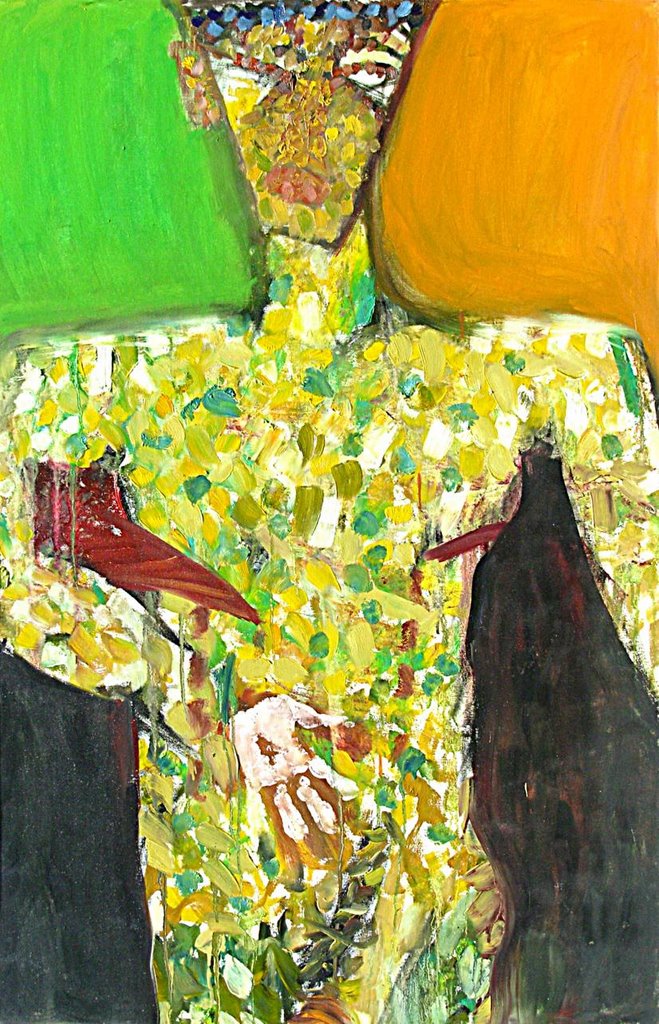
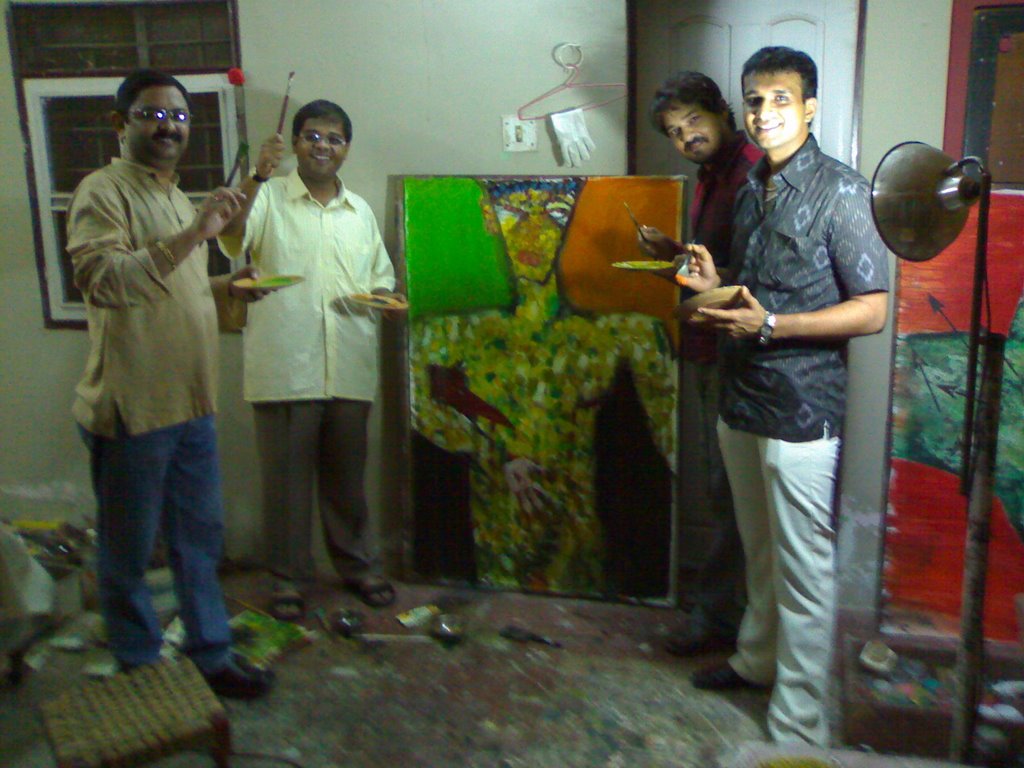
This evening Anuj Sharma, Amit Tiwari, Vijay Nijhawan, and this blogger dropped by Tushar Waghela's studio in Durg. While Tushar was still grappling with his Adam- the Cave hasn't left the poor creature yet- we decided to do "a portrait of an artist (Tushar) at his studio". This is what we managed to come up with.

"A Portrait of An Artist at his Studio", c. 2006. Oil on canvas by Anuj Sharma, Amit Tiwari, Vijay Nijhawan, Amit Aishwarya Jogi


The Artists Pose with their Work


AJ Read More (आगे और पढ़ें)......

Wednesday, August 30, 2006

CHHATTISGARH: MEGHA

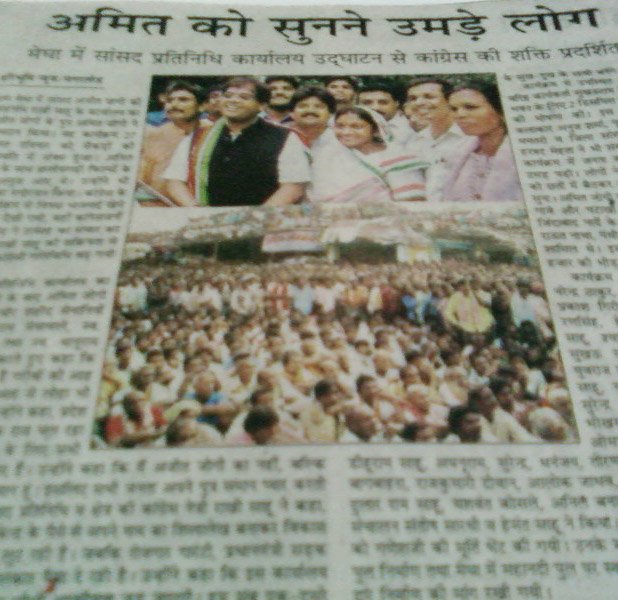
Haribhoomi (28.8.06)

I am grateful to the People of Megha, a village in the Kurud Vidhan Sabha, for the love and affection they showered on me when I visited them this Sunday (27.8.06).

I had always wanted to visit this village on the banks of the Mahanadi, not merely because it is an important part of my father's constituency, but because of its pivotal contribution to our nation's Struggle for Freedom: Narayan Rao Meghawalé, Thanuram Bansaur, and of course Pandit Sunderlal Sharma- all came from here. In fact, Mr. Pradeep Choubey- one of the very few Lohiaites we have in the Congress here- tells me that the Father of the Nation, Mahatma Gandhi, himself once remarked that "I have learnt more about social equality from Pt. Sundarlal Sharma than from anybody else."

Under the present state regime, Congresspersons of Kurud are being systematically terrorized by their local MLA, who is also a minister. During this brief visit, numerous specific instances were brought to my notice. However, they have shown exemplary courage in facing the Terreur, thanks to their proud legacy of resisting oppression in whatever form it may exist.

Indeed, what better place than Megha to seek inspiration?


AJ Read More (आगे और पढ़ें)......

Sunday, June 04, 2006

TRAVELOGUE: Now In the Winter of Discontent, circa 2004


(1)

A Winter Interlude: From the Himalayas to the Arabian Sea

The incredible ecological and anthropological diversities of this antediluvian subcontinent were made manifest to me during the course of the passing week, as I journeyed, variously by means of motorcar, railroad, airplane and steamship, from the snow-draped peaks of the Himalayas to the sunny-sandy beaches off the shores of the Arabian Sea. Quite naturally, this bewildering excursion was not of my volition: fascinating as this might sound, it was portended by the peculiar alignments of planets, stars & other miscellaneous cosmic bodies, which astrologers & soothsayers of this ancient civilization have, since the beginning of Time, deemed auspicious for such occurrences as the solemnization of marriages; and since I am now come of that age when wedlock becomes something of an inevitability, it necessitates that I put-in an appearance, if not at my own betrothal, then at the very least at similarly elaborately contrived affairs involving childhood friends, who lacking my foresight and forbearance to endure parental pressures, are led, like the proverbial sacrificial lamb, to ‘tie the knot’ (here, the expression is entirely merited). Furthermore, I am bound to report (for the benefit of my Curious Reader) that it has been my sorry experience that as a Rule, people can’t remember who attended their weddings but rest assured, they are very unlikely to forget, let alone forgive, those that don’t.

Thus it came to pass that this portentous conjunction of the esoteric arts & human psychology (neither of which, I beg to point out, remotely appeal to Reason) made possible the experiences, which I shall presently venture to revisit in these pages, and whose memory I shall forever, in the bosom of my heart, cherish.

(2)

My Tale begins in a Pink City, christened rather unimaginatively after the peculiar color of its architectures, among which can be counted the globe’s largest astrolabe, visible proof of Descartes’ overwhelming influence on its Francophone founder Sawai Jai Singh; ever since Her Majesty’s Visit almost half a century ago, Jaipur has become something of a cause celebre among the 'White' Races, who bravely confront the extremities of its climate in order to catch manufactured glimpses of a Raj long since lost. Note, my Perceptive Reader, that the city that had formerly lent its name to a peculiarly uncomfortable brand of footwear, still fashionable among the inhabitants of this land, is now become a celebrated eau de toilette, whose musky odor permeates the most exclusive casinos of Monte Carlo.

Since the “Maharaja Suite” at The Rambagh Palace, residence of the last HH to rule Marwar & his wife (named by the People magazine as among ‘the ten most beautiful women’ of her Age) is presently under restoration, I was left with little option but to be content being cooped-up, incognito ofcourse, within the confines of what is labeled “an executive suite”; consequently, I spent the afternoon lounging about on the lawns, under the crisp halo of a bright winter sun, sipping Gin & Tonic drowned in tons of ice. Lunch comprised of prawn cocktail, served in a tall Martini glass with a most marvelous Hollandaise sauce, and an itsy-bitsy sprinkling of caviar, which was anything but Beluga (not that I’m complaining in the slightest). Having thus fortified myself, I prepared for my first wedding of the evening, which was to commence at six o’clock: much as I would have liked to be attired in the garments of the Palace staff comprising, in this instance, of formidable khaki trousers with bulging pockets (I’m sure they have a name for such pants: Jodhpuris?) and a riotous half-jacket, fashioned by a young local designer by the name of Raghubir Rathor, I had to make do with a black Armani two-piece but without the tie (its like having a noose tied around one’s neck). I carried a printed Hermes scarf- present from an estranged former-beloved- should the occasion have called for a dash of color.

As the evening unfolded, my circumspection proved wholly unnecessary.

This wasn’t my first time at an Indian wedding: like the artful film-maker Sooraj Badjatya (who incidentally hails from this state: Rajasthan), I too must have, during the course of the past two decades, attended several hundred; ofcourse, unlike me, Mr. Badjatya had a purpose in undertaking this prodigious enterprise: to create the format of ‘the perfect Indian wedding’ for his film “Hum Apke Hain Kaun!”, which turned out to be among the biggest blockbusters of all time. That movie’s leading-lady inspired the prodigious artist Maqbool Fida Hussain to devote an entire series of paintings on her. Not that they do justice, for it is impossible for any human-device to capture the essence of the ethereal. And it’s not just her: I believe every ‘bride’, during moments preceding her betrothal, evokes in the viewer, images of the divine. My mother never looked more beautiful than in her wedding photographs: it is as if she did not belong to this corruptible world. I don’t know why it is so.
There’s a colloquium in Hindi, which when translated would go something like this: suckle the mango, why bother about the seed? Still, there must be an explanation; or atleast, it must be sought. Culturally, Indian womanhood passes through three phases: in the beginning she is a daughter, beloved of her father, but one he realizes can never truly be his; then she becomes the dutiful wife, her husband’s constant companion and possession, in life as well as in death (the Rajput women were rather proud of their tradition of sati and jauhar, wherein the wife, after her husband’s demise, sits atop his funeral pyre to be consumed by its flames); finally, she is transformed into the mother, prolific bearer of sons (Indians view their country as “Mother India”: the supreme embodiment of self-sacrifice). In each of these phases, she evokes different emotions in the men in her life: adoration from the father; love, even lust, from the husband; and ultimately, devotion, from her sons. As the bride, she combines, in our ‘collective conscious’ (to use Carl Gustav Jung’s term), an incorruptible innocence with an enticing sensuality, metamorphosing at once into an object of worship and lust.

Personally, I find this peculiar conjunction of the earthly with the ecclesiastical endearingly exquisite.

Perhaps, for the very reasons I’ve discussed above, the Rajput wedding is a remarkably conservative affair, even feudal: there are separate spaces for men and women, and the twain seldom meet; on the rare occasion when they must- a marriage, after all, is the sacred/ contractual union of man and woman, as the case may be- strict purdah is observed, which means that the women’s faces remain covered at all times. To an outsider, oblivious of this custom, the entire event might easily be mistaken for a homosexual marriage; in any event, they would return to their homelands attributing to us Indians an undue measure of liberality. {This, as will be revealed during the course of my deliberation on a wedding that I was to attend in another few days, is in stark contrast to the rampant promiscuity present in another form of “Indian” wedding; but the reader is advised patience, which our sages hold to be among the most supreme of virtues.}

Now, returning to the wedding at hand, the Groom made a grand entrance, perched atop an elephant (whose gender I did not venture to determine). During the course of the reception, there was a lot of kowtowing, well not exactly that but something quite similar: the degree one was required to bend one’s torso was in direct proportion to the importance of the dignitary present. Since I didn’t know most of them, I was obliged to merely follow suit. Excellent exercise to boost anybody’s appetite! In any case, being part of the Groom’s Party, more often than not, we were the ones being kowtowed to. {I attended the Groom’s elder sister’s wedding some years back, and in the process, lost a few kilos. This was revenge, sweet revenge.}

I was among the privileged few who was whisked aside to a drawing room, where friends & relatives of the Groom (most of whom were, like me, bachelors) were in the process of consuming fiery kebabs washed down with copious amounts of beer, to be photographed with the Groom & his bride, who came accompanied by an ancient dowager, who doubled as her chaperone. This intrusion of a woman, the bride no less, into the world of excessive machismo- it is not difficult to imagine the kind of conversation that beer inspires among stags- was nothing short of intriguing; when the Groom asked her to remove the purdah, she was blushing wildly. This was done, I believe, as a tribute to my proximity with the Groom.
Afterwards, we proceeded to fire what I hoped were blanks from the freshly greased barrels of ancient rifles, heirlooms no doubt, in the air. Then, when the Groom was called ‘inside’, I decided it was time to beat the retreat.

I had another pre-wedding ceremony- a Cocktail Party- to attend. Talk of killing two birds with one stone, eh?

I arrived at the Cocktail Party at around ten o’clock, and not as clear-headed as I might have liked to be. Thankfully for me, ‘clear-headed’ wasn’t the term one would have employed to describe the general condition of the population present at the occasion, as could be deciphered from the several empty bottles of alcohols of various hues liberally strewn about the place, and the wobbling of feet on the makeshift disco-floor in the backyard. The Groom has recently being inducted into the Indian Police Service (IPS), and the Groom’s father happens to be a Custom Commissioner, so there was no dearth of Single malts.
The bride was not present, and the formal reception was to take place the following day. This was a less formal, more homely and intimate affair: a sort of a bachelors’ party, minus the strippers. I spent the first three quarters of my stay there drinking different varieties of Glens (Glenfiddich, Glenmorangie, Glenlivet, Glenfarclas et al), and the remaining one quarters apologizing profusely for not being able to stay for the reception, for which I was gently reprimanded. The conversation meandered inevitably to the good ol’ College days, and memories of imaginary romances. At around one o’clock, we decided to drive up to the Nahargarh fort, for old time’s sake: despite stories of whimsical ghosts that haunt these splendid ruins, the view from here is quite simply incredible. The city of Jaipur looks like little stars twinkling on the ground; a similar view is offered from the Jehan Numa Palace at Bhopal. Upon our descent, a turban, some six feet in length, was tied around my head by the only person who knew how: the Groom’s ancient grandfather, who at one point, confused his moustache for the cloth.

Then: I left. For Simla, the erstwhile summer capital of the British Raj in India, for yet another wedding.
*

(3)

Six Nights & Days in Goa: An Encapsulation
(16th- 22nd December, 2004)

I hadn’t come to Goa on holiday (although it is that time of the year when everybody else does, partly to escape the Cold but mostly to imbibe the Goan ‘joie de vivre’) : I was here to spend time ‘bonding’ with my American cousin, whom I hadn’t seen or heard from for past three years. In this objective, this particular visit has been an unambiguous disaster.

Had it not been for dear Moks, who I insisted fly-in from Mumbai, where he was giving an interview, I might as well have been a hermit (quite aptly I had, for quite the opposite reasons, put myself up at The Hermitage, a quiet little villa atop Fort Aguada overlooking almost the entire expanse of Caligute beach). He had some prior experience ‘shacking-up’ in Goa but amnesia has set-in: consequently, he wasn’t much help in exploring the ‘hedonistic underbelly of this sea-side paradise’, to which so many of my acquaintances have eluded. Perhaps, this isn’t really the kind of place one would want to visit with a man-friend; rather one should bring the entire ‘jing-bang’, along with a guitar and an excessive, inexhaustible supply of alcohol (the local cashew-feni leaves an enduring stink). Or: it might be nice to be here with one’s lover: everybody else seems to be.

Despite the disaster- which sank in very slowly, and hence afforded me little time to make amends, like drastically reorganize my itinerary to include other fun-activities- we did manage to absorb a bit of Goa (admittedly, much of it has been in the form of food: I’m already dreading my next encounter with a weighing machine, which is happily absent at the Villa here). The single most significant achievement of this visit has been the ‘insider’s view’ we have had to a Portuguese-Goan wedding, with its pre-marital coconut-milk showers (lamentably, we were privy to only the groom’s part of this pre-Portuguese Konkani ceremony), elaborate menus, and abundant, unbridled dancing, which is what I enjoyed the most: the part where the blindfolded groom has to take out the bride’s garter that is aptly tied around her thigh with nothing more than his teeth is magically titillating (or if one prefers, titillatingly magical). The second important experience has been the time we got to spend at the Exposition, with the five century old remains of St. Francis Xavier (thanks to the good folks at the Raj Bhavan). I even partook in a Catholic Mass, my second in three days, which I believe, more than absolved us of our visit- Moks’ first- to an all-night Casino, where my winning-streak, despite my best efforts, continued unabated (remember: lucky in gambling, unlucky in love). I would have said that the third most important aspect has been the sea but honestly I’m not a sea-person. The Hills are for me. Infact the only thing I like about the sea is the sea-food, and for the last six days, we’ve eaten little else: Cafreals, Baffads, Fejoidas, Sorpotels, Vindaloos, Xec-xecs, Julians, Balchaos, Xacutis, Bebinkas…the list seems endless.

Perhaps, this is why Goans are such a jovial, boisterous people: they relish their food, and love their siestas. Small wonder then, that most people I met at the wedding mistook me as one among them!

Amit Aishwarya Jogi
December 21, 2004
at
The Fort Aguada, Goa
*

(4)

Two Emails: from & to a friend, in love with Goa

(a)
Dear Amit,
glad & thrilled to know that you were in Goa. Hopefully, you liked Goa. I never found its beaches beautiful but its the enviornment, energy and ambience of Goa which is unmatchable to any thing in the world. That is my purpose for the club and everything associated with it. Old movies potrayed Goa in the sleezy cheesy way; relatively new movies showed it in a real filmi way and new movies show it in the 'dark' genre - that is the tragedy. Honestly, I did not do anything for the tsunami disaster but am arrogantly proud that our country refused any foreign help & assistance.

Club Goa- I have and am commiting lots of mistakes, sometimes stupid, which is adding up to expereince. There has not been any 'red tape' element as of yet but the landlord, master of predicament, always slows things down. Every fortnight we learn about his illegal 'short cuts' just to get stuck in our work and end up fighting with the City or the Neighbours for him.

Hopefully, the club will start by Summer of this year...Apologies, again. NYE- I went to Ann Arbor, Michigan for skiing with friends and have become the 'James Bond' of that world. It was good fun and a good affordable and available break.

Please stay in touch,
Gunjan


(b)
Dear Gunjan,
i haven't seen this last matt damon film (bourne supremacy, is it?) but i'm told that a lot of it was shot on location in goa; also there's this WWII film with sean connery, michael caine et al called sea-wolves, and that too is based in goa. as far as indian (hindi) cinema is concerned, i rather enjoyed naseeruddin shah's jalwa; also, an early amitabh "bombay to goa" (but the action, as the title suggests, takes place enroute). raj kapoor's bobby too is inspired by its folk culture. shyam benegal's movie- i can't remember the name- belongs to film noir, and deals with witchcraft or some such subject. so: goa has, and continues, to exercise a significant influence in popular cultures of both India as well as 'the West' (although both are becoming increasingly enmeshed). but what is- or is there- a "goan culture"?

that is what my cousin, the one who works for Merril Lynch (is that how one spells it?) in Atlanta, came to discover: his biological father, and my aunt's first husband, traces his roots to margao. since he has recently been diagnosed with prostrate cancer, he wanted to show Josh (that's my cousin's name) his roots. the occasion presented itself in the marriage of ethelbert with (well, i forget the girl's name!), both of whom work for banks (ICICI and HDFC) in goa itself. ethelbert is josh's first cousin. now, i was told that josh would be coming to attend a cousin's wedding. ratna aunty asked me to spend time with him during his short visit. i didn't know about the father-son bonding purpose of the trip, otherwise i wouldn't have been so "available": you know, from our own trip to Dhanolti, that i prefer the serenity of the hills anyday. consequently, apart from the evenings (which were mostly occupied by wedding ceremonies) i had a lot of free time on my hand, which i employed judiciously to catch-up on my reading (David Mitchell's Cloud Atlas, Umberto Eco's The Name of the Rose (re-read), and a coffee-table book on colonial resorts) perched atop a quiet little villa on fort aguada (the place is aptly called 'the hermitage'), which offered an exquisite view of the calingute beach. also, titillated by local gossip, i ventured to explore the more discreet beaches of north-goa: arambol et al (i have developed a chronic distaste for south-goa after my dreadful stay at the Exotica, forty miles south of Vasco, attending a Marwari wedding last year: you probably know the Agrawal family that runs the Dainik Bhaskar newspaper: it was raining cats and dogs, the food was all kachoris and jalebis, and had it not been for Martin's corner, I might not have lasted a day); the all-night casino (where my luck- remember, the Taj Mahal at Atlantic City- continued unabated, and i left the place more prosperous than i had entered it); and best of all, these lovely little restaurants serving portuguese-goan sea-food.

perhaps most significantly, i got to spend a lot of quality time with the body of the blessed St Francis Xavier, at the decadal Exposition. the last time i was there, in 1984 to be precise, i wished "for good health"; the Saint was rather generous with his
blessings! what i found intriguing, apart from the residential presence of the phirang low-budget backpacker hustled in shacks for months together (the purpose of their visitation, I believe, is only too well known to you!), is the subterranean 'clash of cultures': between Portuguese (the Old Elite, of which my cousin's family is a good, if somewhat impoverished,
representation: they still speak Portuguese, and even have Portuguese residencies and passports, and view today's goa as occupied territory) and konkani (the masses, most of whom are fishermen); also, the large influx of Maharasthrians, Mangalorians and even Malayalis (the exotic population now far outnumbers the locals) poses a threat to pre-liberation culture of old goa.

the rise of the bjp, by wholly undemocratic methods, in the state does not augur well for its future: at any time, these tensions may be given a communal colour. there was a lot of resentment among the locals about the vast sums of money the state government spent in its international film festival when it could have gone into generating employment and building
roads; also, much of the mining activity in the state, which remains among the two principal sources of its revenue, has gone into 'non-Goan' hands, since labour from outside the state, especially UP and Bihar, is a lot cheaper. naturally, the young goans have to turn to tourism- become room-boys, drivers et al- or to relatives already migrated to the Gulf for sustenance. thankfully, apart from the nefarious narcotic activity, which I'm informed enjoys the full cooperation of the local law-enforcement agencies, tourism in goa has not been reduced for purposes of sexual-exploitation (pedophilia, as in Srilanka; or prostitution, as in Thailand): that is because unlike other places, the goans are relatively economically self-sufficient.

however, the average tourist to goa isn't really spending much money, as they might in say Monte Carlo or even the Caribbean, and the benefits to the local economy aren't what they can be. well, i think i have already spend too much time deliberating on goa but since you're so intrigued by the place, i thought it best to share with you, at considerable length, my observations on the place. infact, there's a little piece entitled "six nights in goa", which i penned down at aguada, that i'm sending for your perusal.(naturally, much of it will tend to get repetitive). i left goa on the 23rd of last month, ie three days before the tsunami (although goa, being on the west coast, was spared). however i'm told that the tsunami-terror did impact on the new year's bookings, atleast as far as our brave delhiites are concerned.

before i conclude, i must tell you the reason for my literary verbosity: in the aftermath of the new-year's celebrations, i'm down with viral, and almost bed-ridden. frankly, there's nothing else to do.
sincerely,
amit
*
(5)
Joshua Solomon, after 3 years

Personal Reflections on an American Cousin

(transcribed)

More than three years have lapsed since I last saw him; this is not to say that there had been a priori continuity in our relationship: we met only when we had to, and there was no promise- or expectation- of future encounters, not even the need to ‘build-on’ them. The adage that one tends to take one’s relatives for granted applies beautifully in this instance. The distances that separate us have endured, and widened. Technological advancements of past decades (which have- to deploy a phrase from a TIME essay- ‘shrunk the planet to about the size of a grape-fruit’) did remarkably little to bridge them. Yet despite- or is it because of- this that I have always had a special place for Josh in my heart.

More than anything else, it is (in my opinion) based on an acute sense of empathy that must necessarily be due to the commingling of antediluvian bloodstreams: the fact of having, in many ways, been incubated in similar wombs. At times, I wonder if our destinies might have been interchanged, much like Saleem Senai’s in Rushdie’s magnum-opus? That is a thought both intriguing (‘anything is possible’) and also, frightfully troubling (‘what if I am living somebody else’s life?’). So: it is less out of a sense of obligation than plain, simple curiosity of rediscovering my alternate-self- the one I could have been- that I have journeyed to Goa to partake in a ritual with which I have nothing to do, and in so doing, to subject myself to unnecessary exile, becoming an alien in my own homeland while the alien itself is domesticated.

The reason for Josh’s visit was revealed to me only today. It has nothing to do with his father’s brother’s son’s wedding. [After all, he isn’t planning on attending his mother’s brother’s daughter’s wedding, to whom I imagine he should by comparison feel infinitely much closer.] It isn’t about the decadal Exposition of the Blessed Saint Francis Xavier either. There is a veil of finality, an air of solemnity, which weighs heavily on this ordinarily joyous- festive- occasion: the shadow of oblivion; the erasure of lost possibilities frantically sought to be undone; the Child has returned to reclaim a past that can, and will, never be his. But the futility of this last, desperate effort does not make it any less meaningful.

Seventeen years ago- was it in 1987, I can’t remember- he had come, a shy-kid: that event was pregnant with possibilities. There was every chance he might have stayed, and our destinies would not have been so different after all. Fate willed otherwise. Now he has returned, if only to bid adieu to the land of his forefathers. [Perhaps he doesn’t realize this yet?] It is strange the relations children weave with their fathers; in Josh’s case, I know only half the story, and not even his half. Whatever little it is I know of “Uncle” Jossie Dias is from my aunt (Joshua’s mother): in her version, he abandoned her, and with her, also Josh. I do not wish to recount the sordid details, but rest assured, they are cruel: sufficient to scar a child for life. When I visited them in 1995, I got the distinct impression that Josh had already ‘found’ his ‘Dad’ in the person of his step-father (also: long since divorced from Aunty). It was not out of love; quite simply, there was no one else to fill the void: yes, Josh admired Dr. Gera, not for the affection he didn’t shower upon him (which in any case was not his to claim) but for the adulation- one might even go so far as to call it blind devotion- he exhibited towards his own son (Josh’s step-brother from the same mother). Six years later, in 2001, when I visited the States again, he had come of age: his own man, living- and working- in Atlanta, away from the looming shadows of mother, father, step-father, brother. I believe it was during this interregnum that he rediscovered his biological father, independently of everything and everyone else. By this time, Uncle Jossie too was transformed by the experiences of several failures: the promise of a prosperous future squandered away and wasted, he finds consolation in the one tangible his past offers him: his aborted dreams conceived again, in the flesh and blood of his blood and flesh; the sweet hope of immortality at the face of grave illness; a dying flame, suddenly rekindled. Or, to use his own words, “blood may be thicker than water, but Sperm is a lot thicker than blood”.

I imagine the present visitation to be the outcome of these conjectures: the son, in what is most certainly a twist to the Biblical parable, embraces the prodigal father, now returned. If this is an ending, it is a happy one.

It is never too late to search for one’s roots- I tell this from personal experience, for my search too has only just begun- but in Joshua’s case, I’m afraid there’s nothing quite there to look for; my dear Cousin will necessarily have to cultivate- plant, grow and nurture- his roots, in the hope that his generations to come will find their way home. Ofcourse where they choose to go from there, is upto them. But the sense of ‘rootedness’- of belonging- is essential, even more so for displaced children of diasporas: in the imagined soil of our ancestral graveyards, the miasma of identities, coiled like cannibalistic serpents of Benzene-dreams, crystallizes into a prism upon which, when the light falls, our multiple-selfs are revealed all at once. It is like standing atop the blind poet Borges’ “El Aleph” from where he beholds “all points that meet without mingling”, and suddenly, as if by magic (only it is wisdom, I think), he becomes omniscient. It is the mechanics of motion, captured for a brief but beautiful instant, in the description of chariot-wheels, in Kalidasa’s opening verse in “The Loom of Time”.

Let it be that at the end of days we may proudly proclaim: “I have traveled far and wide, and come home.” Home is where we choose to be.


Amit Aishwarya Jogi

December 14, 2004
at
The Fort Aguada, Goa
*
Read More (आगे और पढ़ें)......

get the latest posts in your email. ताज़े पोस्ट अब अपने ई-मेल पर सीधे पढ़ें

Enter your email address:

Delivered by FeedBurner

DISCLAIMER. आवश्यक सूचना

1. No part of this Blog shall be published and/or transmitted, wholly or in part, without the prior permission of the author, and/or without duly recognizing him as such. (१. इस ब्लॉग का कोई भी भाग, पूरा या अधूरा, बिना लेखक की पूर्व सहमति के, किसी भी प्रकार से प्रसारित या प्रकाशित नहीं किया जा सकता.)
2. This Blog subscribes to a Zero Censorship Policy: no comment on this Blog shall be deleted under any circumstances by the author. (२. ये ब्लॉग जीरो सेंसरशिप की नीति में आस्था रखता है: किसी भी परिस्थिति में कोई भी टिप्पणी/राय ब्लॉग से लेखक द्वारा हटाई नहीं जायेगी.)
3. The views appearing on this Blog are the author's own, and do not reflect, in any manner, the views of those associated with him. (३. इस ब्लॉग पर दर्शित नज़रिया लेखक का ख़ुद का है, और किसी भी प्रकार से, उस से सम्बंधित व्यक्तियों या संस्थाओं के नज़रिए को नहीं दर्शाता है.)

CONTACT ME. मुझसे संपर्क करें

Amit Aishwarya Jogi
Anugrah, Civil Lines
Raipur- 492001
Chhattisgarh, INDIA
Telephone/ Fascimile: +91 771 4068703
Mobile: +91 942420 2648 (AMIT)
email: amitaishwaryajogi@gmail.com
Skype: jogi.amit
Yahoo!: amitjogi2001