Showing posts with label prison. Show all posts

Wednesday, November 01, 2006

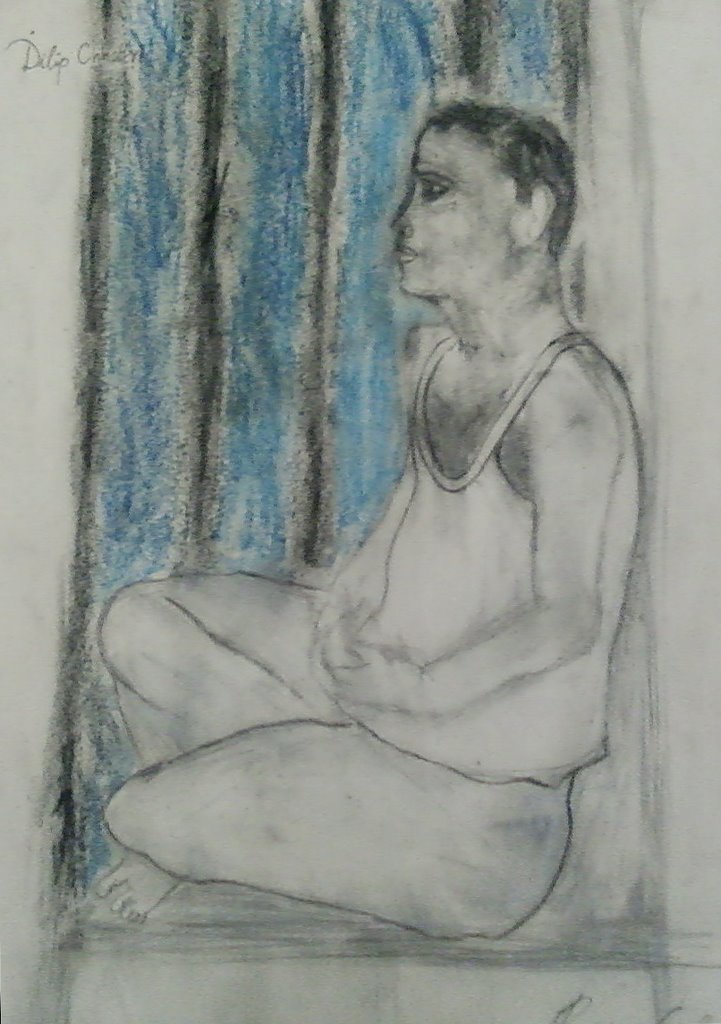
PLAY: चल बे कपङे उतार: Story Board

The storyboard of the play runs something like this. Vikram, a young boy of 18, is brought through the spectators’ gallery to the stage, escorted by a cop, who knocks at the jail gate (the curtain). It opens, like Ali Baba’s cave, and Vikram enters ‘the world of prison’: the first sentence he hears is Chal bé kapadé utar (go on, strip). From then onwards, till the very end, he remains naked, even when clothed, his action, even his thoughts, always visible to the surveillance devices of the modern Panopticon. In the first act, he and another inmate, Jai, become objects of an auction: two numberdars (that’s what they call Convict Overseers, chosen from among those sentenced to life imprisonment, to help with the day to day running of the jail administration etc.) buy them for Rs. 300 each, from the officer incharge of the Warrants Department (responsible for the allotment of barracks). However their bid is ultimately foiled by Dilip- the play’s central character- who reminds the concerned officer that since they are under 21, they should be sent to the ‘Kishor Ward’ in accordance with jail manual provisions. The second act takes place in the ‘Kishor Ward’: Vikram befriends Raju: ‘the only convict (he finds) in jail who doesn’t declare himself innocent’. The numberdar incharge of Kishor Ward, Udu, claims that Jai is his friend’s son, only to sleep with him later in the night. Vikram and Raju witness this: Raju tells Vikram that this is what Jai has to do if he wants a better lifestyle in jail; he also points out that Jai, from the sounds that emerge, doesn’t seem to mind. Next morning, over breakfast, Vikram confronts Jai, who confirms what Raju had already told him (‘a hole is a hole, whether in front or behind!’); he also propositions Vikram to a ménage à trois.

In the next scene, we meet Dilip being harassed for ‘diwali money’ by the head-warder; Raju tells him of Vikram’s predicament, and Dilip assures him that he will ask the Octagon incharge to get Vikram transferred to Ward Number One, in which mentally-challenged convicts are kept, so that he can be with Raju. In the next act, we witness the monthly auction of prison-factories, barracks and other other concerns of the prison economy, which the octagon incharge gives to the highest convict-bidder. Dilip’s group is pitted against Narad’s group. The act ends with an announcement on the public address system asking Dilip to report to the Visitors’ Room. In third act, Dilip shows Vikram, who is returning from meeting his only relative, an ailing grandmother, the cop who was responsible for falsely implicating him for a murder he did not commit, but ended up in jail himself on a charge of custodial-death: he tells Vikram that he will avenge himself, by watching his captor ‘die a million deaths everyday in jail’ and after his release, he will go to his house and rape his daughter, who incidentally has taken a liking for Dilip. As Dilip goes to the visitors’ window, Vikram witnesses another scene between a convict, his wife and two kids: the convict’s outburst; frustration at the legal system; repentance and sense of total loss; bribe paid to the warder for ‘smuggling’ in the basic necessities of life. On his way back, we notice an unopened letter in Dilip’s hand.

The next act takes place in Dilip’s ‘masala factory’: Dilip reads his letter; he screams; a new convict is produced before him; he has a young son, who Dilip takes an instant liking to; when everybody leaves, Vikram picks up Dilip’s discarded, crumpled letter. In the next scene, we are in the ‘mental ward’: a corpse lies unattended on a cemented platform; deranged convicts light their bidis with the incense-sticks, burning next to the corpse’s feet; a group of convicts decide to pass time by playing cards; a warder joins them, and when he is caught cheating, confiscates the cards and all the gambling money; another convict, Naresh, tries to sell Vikram marijuana; Vikram reads Dilip’s letter to Raju and we discover that his daughter died of pneumonia; during the power cut that follows, Raju is emboldened to ‘hint’ his true feelings to Vikram.

It’s day, and we see the lunatic-convicts being given their weekly bath in preparation for the Parade. Vikram is impressed at the selflessness of those convicts who are bathing the lunatics; Raju tells him that their real motive is that they get to sell the lunatics’ rations- eggs, soaps, Colgate etc.- in the prison-market for ten times their actual cost; Dilip gives the young boy a bath. Everybody lines up for the Parade. A retinue comprising the jail superintendent, jailor, officers incharge, doctors and warders arrives. A prison-don complains to the superintendent about the unattended corpse they had to sleep with; this leads to an altercation, in which the don ends up slapping the superintendent. Immediately an ‘alarm’ is sounded, in which the officers and warders brutally beat up all the convicts, including the young boy. The next scene is the same as the previous one, except that all the convicts are in bandages. We learn from their conversation that the don has been transferred to some other jail, and that as a result of Dilip writing to the human rights commission, some officers are coming to do an inquiry. Most of the scene consists of a dialogue between the human rights officer and Dilip, who decides to tell all: the dark underbelly of prison life is brought to light. The real quality of prison food, the ‘death-factory’ medical system, in which each death presents a postmortem windfall gain for the authorities, and rampant corruption everywhere. In their defense, the jail-administration declares Dilip mad, citing that he is suffering from the shock of not being permitted parole to attend his daughter’s funeral. The human rights officer concurs, and he is shifted to the ‘mental ward’ for ‘treatment’, under his bete-noire, Narad’s supervision. As they leave, the superintendent compliments the human rights officer on his wife’s excellent taste at having selected the best pieces of furniture from the prison carpentry store.

The next scene is a ‘play within a play’: a rehearsal is underway for the prison’s annual drama, to be enacted in the local dialect Chhattisgarhi, with each convict taking on a role. It is a morality play called ‘jaisi karni waisi bharni’ (what one reaps, so one sows). Raju trumps Narad in getting the hero’s part. The story-line of this play is fairly simple: a boy leaves his mother to seek his fortune in the big city; on the way, the caravan is looted by robbers; while everybody else escapes, thanks to the boy’s help, he himself gets left behind, whereupon he decides to dress up as a woman; the leader of the robbers takes a fancy to the boy-woman, and takes him to his house; there the boy falls in love with the robber’s sister- played by Vikram- and the two run away with the robber’s loot. In the love scene between the boy and the robber’s sister, Raju and Vikram deviate from the script and begin to confess their feelings for each other, when suddenly, Dilip- who had always played the hero’s part- makes his entrance. Narad and his gang try to catch the ostensibly mad Dilip but it is Vikram- the robber’s sister- who ultimately convinces Dilip- who thinks of himself as the play’s hero- to stop his antics and return. The following scene is a soliloquy by Dilip, naked and wet in a solitary-cell. It is recited against the backdrop of diwali-crackers bursting in the distance: is he really mad, or just pretending to be? He is woken up by Raju and Vikram, who tell him that they have a novel plan of turning the table on the jail-administration, and exposing what really goes on behind the prison-walls. The president of the republic is to be the chief guest at the state foundation day function, and the cultural department has asked for the convicts to stage their play. Except that instead of ‘jaisi karni waisi bharni’, they- the prisoners- have decided to do something different.

In the final scene, the superintendent makes a short welcome speech for the chief guest, and ends by introducing the play. The play begins: Vikram, a young boy of 18, is brought through the spectators’ gallery to the stage, escorted by a cop, who knocks at the jail gate (the curtain). It opens, like Ali Baba’s cave, and Vikram enters ‘the world of prison’: the first sentence he hears is Chal bé kapadé utar (go on, strip).

Of course, through this play, it is not Vikram- and his motley group of convicts- who strip; instead the entire ‘technology’ of our carceral system is laid bare before the world, or so I hope.

Your comments and ideas on production, stage-direction, story etc. are, as always, welcome.

AJ
Read More (आगे और पढ़ें)......

Tuesday, August 15, 2006

Jail Diary: (C) On Independence Day: An Undertrial’s Thoughts

Jail Diary Entry of 15th August 2005
It has been a week since I turned 28: flowerbeds we planted a month ago alongside the two-feet wide pathway, which circumbulates this ‘high security complex’, are resplendent with riotous blossoms, the transience of which is not entirely lost on me. This forenoon, the recently appointed Minister (Home & Jail) has been invited to preside over some sort of a ‘cultural program’ at the Prisoners’ Club in the Old Octagon, where he is expected to distribute carpenter’s tool-kits and sewing machines to life-termers who have served out their fourteen-year sentences, and will be set free today. Visitors not being permitted on holidays, I expect to meet no one- Papa, Mummy, SNT et al- today, and perhaps also tomorrow.

Another week of waiting begins.
*
Possibly for the first time in my relatively short life, I begin to understand the fuller significance of Independence Day (ID), paradoxically while I’m locked-up in prison: it is not Pandit Nehru’s ‘tryst with destiny’ speech, with its beautiful metaphors and an unfortunate horological error (‘when the world sleeps, India awakes…’- as a matter of fact, more than half the world was wide awake), that comes to mind but a far more universal truth- episteme- articulated by the legendary South African cardiac surgeon, Dr Christian Barnard: recounting his experience with the first ever human heart transplant in history, he writes that ‘one who has not experienced darkness cannot see light.’ The plain truth is that up until forty-five days ago, I had taken my freedom for granted: it was a condition I was born into, and very frankly I knew of no other; the notion that it could as easily be taken away did not cross my mind, and in that sense at least Mr Sood (see entry of 13/8) is right: opposing my bail before the Hon’ble Chief Justice, the flamboyant lawyer proclaimed that I ‘exercised my freedom with impunity’. But I find it rather difficult to believe that a majority of my fellow citizens don’t, including Mr Sood himself. In fact, the phrase ‘freedom is my birth right’ implies a certain level of irrevocable impunity: that the exercise of freedom should necessarily be done without constraint, or fear of consequences. However the ‘exercise of freedom’ cannot be given to mean that one can take another’s freedom with impunity; to think that freedom as a right can be divorced from freedom as a duty defeats its very function. The question then is: at what point does Society acquire the right to take away a person’s freedom? The theoretical answer is clear: at the precise point when that person’s freedom becomes incompatible with its own. In praxis however, this clarity gets lost in the various interpretative traditions this question evokes.

Admittedly, from my peculiar point of view, the issue of freedom cannot remain a matter of academic curiosity but instead enlarges itself into a subject of existential concern; in fact, at the risk of sounding melodramatic, it has become ‘a matter of life and death’. Broadly speaking, there are three alternative paradigms- legal philosophies- out of which I’ve already expounded, very briefly, on two (see entry of 9/7). First, a person is guilty- i.e., deprived of his freedom- till he establishes his innocence. Secondly, he is to be presumed innocent- and hence a free man- until his guilt can be proven by persons- or agencies- that accuse him. There is a third also, which brings into play the greatest possible measure of discretion on part of society- and state’s- judicial apparatus: ‘the Principle of Graded Complicity’, in which a person’s guilt (translated as deprivation of personal freedom) is in direct proportion to the level of ‘suspicion’ the prosecution’s investigation (collection of evidence) of the offence gives rise to: is the presented evidence sufficient to establish complicity even before the commencement of trial? On an intellectual spectrum, this third paradigm is in remarkable proximity to the first since it accepts the possibility of a person’s guilt till he can otherwise prove himself innocent, thus sanctioning his ‘lawful enslavement’- the condition of every undertrial prisoner- on as flimsy a ground that the novice Superintendent of Police supervising the investigation, as is my case, found the accused rather ‘arrogant’ (this is what he told his superiors anyway). What the officer doesn’t realize it that ‘impunity’, as he sees it, comes not only from a sense of immunity- something I couldn’t possibly have deluded myself into accepting, since I did go for questioning of my own accord, and with a packed suitcase- but also because the person believes firmly in his own innocence. Why then go with a suitcase? Simply because while I am convinced of my innocence, I am also equally- if not more- certain of the absurd extents to which my Prosecutors had gone to ‘frame me’, a fact that can be evidenced from day before yesterday’s proceedings: the legal has unfortunately become viciously personal.

The fact is that most prisoners are here due to two reasons: one, personal rivalries not only between parties to the alleged offence but also more significantly, between the prosecuted and the prosecution itself; two, the fact of material expendability of the prisoner, indicated most often by his poverty (broadly defined here as the paucity of wherewithal to advance one’s interests vis-à-vis the Establishment). In the first category are ‘prisoners of personality-politics’ and the second is constituted of ‘prisoners of poverty’. Between them, precious little space is left for ‘prisoners of penalty’: people who have actually committed the offence they are charged with. While I would most obviously put myself in the first bracket- perhaps more a prisoner of politics than personality- the question of freedom becomes more pertinent to the ‘prisoners of poverty’- those unfortunate souls who form my present and immediate society. On the eve of India’s 58th Independence Day, I choose to speak out for these silenced creatures, the singularly most ‘banal’ victims of the contemporary state and its rationally devised system of ‘norms’, which as this analysis will reveal, has become the most oppressive technology responsible for their condition: the application of Foucaldian archaeologies in the context of the Indian Penal System yields an equally elaborate- but not as ‘discreet’- use of Power.
*

The technology for the systemic use of power operates at two levels: one, the performance of policing expressed both as reduction in reported crimes and increase in the number of convictions secured against them; two, the valuation of lower-judiciary (below the level of High Court) in terms of the proportion of convictions in relation to acquittals awarded by a presiding officer. Not surprisingly, both these levels justify- and propagate- each other. The practical impact of this dual technology invested in India’s juridico-penal apparatus is as follows: under-reportage of crimes that can be overlooked- such as white-collar crimes, domestic abuse, and non-homicidal crimes involving the silenced poor and the marginalized- in order to reduce the number of offences that are registered in each thana (police station). This means that only crimes of a severe nature- mostly homicides in which a mutilated corpse is produced- are recorded, the punishment for which is life-sentence or death at the scaffold. Then, once such a crime has been registered, there exists a further compulsion to ‘close the file’: an act that must necessarily result in arrests. Under the circumstances, the temptation to solve the case by ‘framing’ persons considered undesirable (anti-social) or expendable (marginalized) or both. Promptly, a confessional u/s 164- or if that’s too much trouble, then a police statement u/s 161- of the Cr.P.C. is beaten out of them, with the reassurance that the ‘evidence’ is so flimsy that they will most certainly be acquitted by the court. This explains why it is often the ‘history-sheeters’- those who have been convicted previously- that are sent back to jail in what becomes a self-fulfilling vicious cycle. Once the police procedure is completed, the judicial procedure takes over. Here too, since the performance of the trial court is evaluated internally based on the number of convictions- with the kind of pock-faced investigation done by the police, it shouldn’t in the least bit surprise anyone that our nation’s conviction-rate is abysmally low- it is a foregone conclusion that those persons who cannot afford a proper legal defense- which in any case is becoming increasingly expensive- or, to put it differently, cannot make it excessively difficult for the presiding officer to convict, end up in jail, more often than not in total disregard of the evidence brought against them by an equally incompetent prosecution. The reason is simple: a conviction removes all doubts of external influence and bias.

In most cases, the appellate courts usually overturn such systemic-convictions. At this point of time, it is safe to say that the proportion of ‘non-poor’ prison-population is less than 1% (myself included). The ‘System’ thus operates as a ‘filtration-plant’, systematically weeding out the impoverished, the marginalized and the delinquents (‘history-sheeters’), who can collectively be termed ‘prisoners of poverty’. As described above, at the core of this problem- if one chooses to see it as such- lies the technology that seeks to define ‘norms’- reduction in the number of FIRs registered and increased arrests (Police); higher conviction rate (Judiciary)- in apparently altruistic ways.

What this description reveals is that altruism- good intentions- does not necessarily result in beneficial- good- outcomes; they may just as easily be perverted. If anything, this altruism reflects, and is a product of, the narrow interests of a particular section- I refuse to use the word ‘class’ in the Indian context- that can broadly be categorized as ‘the haves and the have-mores’, and to that extent, it can be said to fulfill its purpose: they- the elite- are automatically de-criminalized at the expense of the ‘have-nots’; a fact that breeds a further mythology that ‘poverty breeds criminality’ whereas it is really the System of perverted norms that breeds this notion and provides credence to it, in form of demographical data related to the sociology of crime and indeed whole of the discipline of criminology itself. In fact, it is this attribution, at once systemic and scientific, of criminal behavior to the ‘prisoners of poverty’, which authorizes and justifies the deprivation of their freedoms, both at personal and social levels, where it serves to sanction a more invasive and oppressive system of Surveillance in those localities where they live under the pretext of crime-containment, the philosophy being that ‘prevention is better than cure’. In India, where housing is not merely based on economic criteria (HIGs, MIGs and LIGs- referring respectively to higher, middle and lower income group residents- is part of the official nomenclature of state-run housing board corporations) but also communal (Muslim areas, Brahman-paara etc.), this implies that the technology of surveillance is not restricted to the poor but also sui generis targeted against certain communities as a whole. Yet again, a vicious cycle finds completion, with surveillance feeding on sociological, stereotypical and statistical suspicions of criminality and also giving rise to them: a snake devouring its own tail.

In the final analysis, this carefully constructed linkage between criminality and poverty- a linkage I’ve endeavored today to deconstruct by deciphering the manner in which state and society use Power with respect to its often altruistic norms- becomes both the cause and effect of the deprivation of absolute freedom. To recognize this reality is to accept the fuller meaning of freedom and guarantee its uncompromising universality, thus removing the anomaly that ‘some are more free than the rest’.

I can think of no better way to celebrate- and ‘cerebrate’- this Independence Day.

Jai Hind.
*
Read More (आगे और पढ़ें)......

Friday, May 26, 2006

JAIL DIARY: Parts One and Two: April 29- July 8, 2005

PART ONE

(A)
WANDERER

April 29, 2005
Tomorrow, I return to Raipur , possibly my first visit this year: as always, it gives me little cause for celebration- people who gave this urban necropolis a certain degree of humanity shall remain conspicuous by their common and several absences, and the city itself shall take on the tenor of J’accuse. Still, how can I forget that the day itself, taken out of its miserable habitation, is by far the most precious of all? When I do ‘look’ at Papa- and I mean really look, not just see, which to me is an unconscious act, the involuntary function of the eye- I feel blessed, undeservedly so. To be born into such self-made greatness can be overpoweringly humbling: to be measured up against that which is surely immeasurable, and in my case, to be universally acknowledged- nay, condemned- as the sine qua non of his myriad miseries that Life- Fate, Destiny, God- reserves for a chosen few. Rationally, it might be possible to convince myself otherwise. But Reason is for the weak-minded- ah, the painful Paradox of Providence!
No: despite protestations to the contrary, I cannot but help feel passionately about Papa: he has become- and biologically speaking, always was, is and will be- the Essence of my Existence. Gladly would I sacrifice myself for him to be able to walk once again. I imagine those legs spring to life as the firmness of their musculature resolves to produce gallant, majestic strides: lo, he resumes his place at the avant-garde:
Ekla chalo
And others follow.


I visualize the musical-imagery: Stravinsky’s Rites of Spring. The primordial lake churns, giving birth to Life. And it pains me to realize that this is one gift I cannot give- and the one gift he yearns for the most. What I can try to give him instead is Hope: I’m told that it is an elixir that works magical wonders.
*

May 2, 2005
Verily, I rejoice at this unfolding Tragedy of Errors & Gross Miscalculations: from a myopic distance- a luxury I haven’t quite attained- it may even be a simulacrum of Comedy, with all the noble-minded souls blundering through the business of life. I can’t remember when the witch-hunt began: it would be prudent then to assume that I (part now of an abstract ‘we’) invited this Inquisition upon myself; or was this part of some divine plan, a further comedy? ‘For forty years Thou kept me wandering in the deserts…’ One day, I shall look back at this scribbling, and laugh at it, its sheer absurdity:
But literature- that shrewd and insatiable chronicler of human foibles, desires- has already recorded for posterity my hopeless anguish in ways I neither have the time nor flair for: I am now become Josef K., in ‘der prozess’ of being tried for crimes I know not of; except that K. was an island, the extreme-representative of human alienation in a Weberian (bureaucratic?) age- and I am not. I watch in increasing, anticipated horror as men I have known are marched down the gallows. It is the waiting- the ceaseless, slow gnawing of the soul’s fibres, helplessly witnessing them wither, peel-off bit by bit by a surmounting uncertainty- that is so intolerable. In the background, I hear my enemies snigger. Oh, what fate is this to die so many, many times in a single existence! [Death, when it does come, shall not be a novelty: this is perhaps my only respite.]
And how does one categorize this- fleeing, absconding, holiday, exile, banishment, refuge, quest for a safe-haven, a hiding-place…? I am I, and this is this: the time, the place, the person. All are discernable, quantifiable, tangible, discoverable entities, so surely this isn’t- can’t be- running away or hiding? If anything, I am running and hiding from myself…
*

May 4, 2005
1.1 I find familiarity in strange places: the language, the customs- even the sense of shared histories- paradoxically reinforces dialogue: in not knowing, I understand. That is the truth: it exists without reference to, and independent of, all social construction; it is eternal, ethereal: timeless, without time. Perhaps this is what the Sage meant when he diagnosed thus: the more I know, the less I understand. In the Information Age of today, there is some merit to be found in this archaic truism. The ever expanding, increasingly menacing web of information (also: communication, the transmissions of information) suffocates my freedom, my sense of privacy, my understanding. My very being begins to dissolve. Infact there is only one thing more lamentable than the excess of information: it is the absence of it. On closer analysis, the present dilemma puts me inexorably in both these situations simultaneously: of excess and absence, a confounded conundrum from which there seems to be no escape.

1.2 Am I so self-obsessed as to have forgotten the plight of those that suffer for me as well as those others who strive tirelessly so that I may not have to endure further sufferings based on falsities? The shame of it! The only justification- meek, I admit- to be offered is this: I’ve never seen these significant others as different from me; we are all- you and I- the same; ‘one species’, as Czeslaw Misolz, the Czech poet, put it. This sense of excessive self-identification, I inherit from my father; but while he applies it to abstractions- the state, for instance- I do so for real people, made of real flesh and blood and bone. It makes the pain- the agony and the ecstasy of it- so much more cathartic: life’s little moments become one unending finale of a cumbersome, somewhat accurately prophetic, and tearful Greek tragedy; all the myriad characters brought together by a still invisible design begin to die, little by little, slowly; in the interregnum, their faith- in themselves, their gods, each other- are subjected to gruesome-grueling tests; the bondage twists the bonds- the savage multiplicity of bodings, broodings and bondings- beyond recognition: humanity reduced to a tiny crucible of gnarled metal, the wiry tissue of an inanimate soul. [Papa, with his lovely-lovable abstracts, is thankfully spared the fullest onslaught of this torment: it becomes subtle, diffused, and both mistrust and faith are applied universally, indiscriminately into a system of thought that embraces entire worlds.]

1.3 I’m confronted with visible evidence of treachery: a testimony given under duress- of Law, Family, whatever- that will necessarily be misconstrued as further, direct proof of complicities. What should one do: forgive and forget; turn the other cheek; forgive, ‘seventy times seven’? The Biblical precedence is clear, non-debatable. Yet, I cannot but curse myself at this grotesque folly: one individual, blissfully blundering through life, has- in Destiny’s artful hands- the power to destroy so much of my civilization; and to have overlooked in my nicety this incredible fact is quite simply unforgivable. So: while I’m now- or will be in the due course of time- prepared to forgive him, perhaps even forgetting what I have forgiven, leaving him to God’s Greater Judgment, I cannot do the same to myself. I have come face-to-face, mano a mano, with my Judas! Will my God spare me the finality of Crucifixion; or must my blood be shed, transformed into rubies? Did not our Beloved Christ become victim of the politics of his day? Ah, the Megalomania resurfaces its ugly head: such Vanity! Lord Forgive me:
‘Et tu Brute’
Then fall Caesar.
*

May 7-8, 2005
An Unfinished Travelogue
1. Scarcely the time to be in Chennai; yet, for altogether different reasons, I find myself making this long, sweeping journey from the centre of Vidharba, on the steaming, plateaued road cutting though Telengana- the NH 7- to that strange country that lies beyond the Vindhyas, and farther still, on a magical highway perched precipitously alongside India’s southernmost eastern seaboard, to the Sacred (Minor) Basilica of Our Lady of Good Health. In between, I meet wondrous people, sample boisterous food and catch glimpses of incredible cultures and civilizations scattered across space and time.
2. What perplexes me most, much more than the incomprehensibility of this place, is the sense of familiarity- also, freedom- I have come to have in this alien world, where I neither comprehend the dialects (the spoken words), of an altogether varied linguistic descent than my own, nor appreciate fully the subtleties and nuances of ‘Dravidian’ cultures. There is however no doubt in my mind that the people here are more civilized than anywhere in the north: their approach to life is so much more constructive. Ofcourse this is a gross generalization, an over-simplistic stereotyping of an entire region and its inhabitants, and what is worse, by an admittedly non-proficient authority on the subject.
3. The little legitimacy of my claim is based then on two premises: first, my six-year long schooling in the Nilgiris; and secondly, the totally detached, objective perspective I can bring to bear as an ‘Outsider’. [Notice, how these premises contradict each other.] Perhaps then, the reason lies in a more universal Truth, and has nothing to do with my own peculiar experience: - the relation between knowing and understanding becomes inverse. The less I know, the more I understand, and vice versa. Hence this sense of familiarity?
4. To begin with I must submit a record of my peregrinations, a trajectory thereof, these past few days: (unfinished)
*

May 15, 2005
It’s all here, crystal clear: the Signs & Portents of Fall. Papa’s illness- his brutal confinement to a wheelchair coupled with the necessity of being out there, in public life, makes his deficiency, but also his incredible superhuman fortitude, even more agonizing not only for him but also us [I don’t know about Mummy: she remains an enigma; her calm exterior, when it comes to other people’s problems, can very easily be mistaken for a steely-nonchalance, even a sort of basking in a pretentious halo of selfless charity of the dutiful wife of a handicapped warrior, the miserable mother of a miserable criminal-]- well, Papa’s illness is only a symptom- an anatomical metaphor- of this family’s- an aborted would-be dynasty, really- coup de grace: it is sudden, to be sure, missing none of the elements of catharsis, but also painfully slow in its unfolding termination: a candle smoking procrastinatedly before its final extinguishment, its hazy white taking an eternity to metamorphose into grey, and then a million other shades before it is consumed by the primordial blackness of the Night. The one thing that sustains us through this lamentation is the ever-present Hope: hope (a hope-psychosis?); a belief in magic; a miracle that will put an end to Reason; an experience, wished-for, yet totally contrary to all present and past evidences. In retrospect, it appears that the signs were all there, as were the noises, loud and clear; only we chose to be deaf-blind-mute, confusing Power with Permanence. Oh, the Fools’ Fall! A sort of morbid complacency set in, enduring even after the end, imparting everything with a certain bitter aftertaste. Now: I feel as if the same morbid, moronic complacency has returned, to haunt us: Papa chooses to believe- no, hope- because that is perhaps the easiest way out, but ‘when the cocks come home to roost’- and I pray that that day and hour never come, calling upon all my reserves of Faith as also my Creator’s infinite capacity to forgive (no, not for a sin I did not commit but for which I’m now perhaps to be charged)- I know what he will say, as he has so often in the past: “we will face it.”
Only there will be nothing left to face.
*

May 18-19, 2005
This sad season is unending: a ceaseless epoch of polite miseries and discreet mishaps. The family survives despite the cracks, which are only too visible; and I am punished for no particular fault of mine, except those in my mind…friends, in order to survive, abandon me; some remain, but there number dwindles with every passing day: I recoil, preparing for- and half convinced of the logical inevitability of- the ultimate Doom; my only complaint, if I am allowed to make it, is that it has been too long in the making. The one thing that sustains me is Hope: a dying body’s expectation of immortality: the serendipity of a healing that may- or may not- come.
Tomorrow is another day, and I might not be here.
*

May 20, 2005
Each passing day brings in its stead sad tidings of diminishing hope, edging us towards desperation: we’ve been here before, a thousand times over, never for once anticipating return, but such is its magnetism, a whirlpool of bloody mishaps: Destiny’s Quicksand…that the ‘comings-back’ now seem inevitable, as if the escapes were only an illusion, and this, the only reality. Each time we convince ourselves of having learnt from the Lessons of History, not realizing that in India, histories are cyclical; a devious contraption that brings- to use Anu’s elegant phrase- ‘the end back to its beginning, the beginning back to its end’, disallowing deliverance; an infinite time warp caught up in infinity.
Again and again, I cannot but help feel like Josef K. (the image never really leaves me), facing Trial for a crime I couldn’t have committed.

‘Like a dog.’
*


June 19, 2005
Monday, the twentieth day of June 2005: a date that will forever transform the shape of things to come; the ‘archaeology’ of my existence, to use Foucault’s term from ‘les mots et les choses’, depends on the decision one man- a human being, just like you and me, who is now chosen by Fate to judge my fate- makes; perhaps he has already made it- having dictated it to a sleepy stenographer?- but I have no way of knowing. Will he act on the basis of evidence presented- all pointing to a menacing conspiracy built upon the inexplicable and reckless vengeance of an ‘intelligent fanatic’- my Prosecutor, who has for the past year or so ‘lived’ me- and the collective cowardice and treachery of those I had once trusted with my life- or will he be influenced by the systematic campaign of slander that has been mounted over the past four years to defame me? My Prosecutor’s overtures seem false: his apparent cry of helplessness- of having to follow Orders from an enigmatic Above- cannot hide the secret pleasure he must feel at my persecution, the fact of ‘having cornered me’: perhaps he is deluded into believing, like all fanatics, that his crusade is both moral and justified. I have become his raison d’être. In another week or so- ten days, at the very latest- he shall confront me, finally. He knows more about me that I do; but his knowledge is limited to the painstaking re-documentation- or more precisely, caricaturization- of my past- the things that happened in it, what I did, who I met and spoke to, where I went- and all of it confounded by a precipitate-consolidation of false perceptions: a misconstrued cognito. I shall not question the facts; the words he has put into the mouths and testimonies of others, by means of enticement and brute force, I cannot support for they are falsehoods uttered with the sole objective of implicating me; the presumptions about my personality- who I am? - I will do my best to destroy, to reclaim something of myself.
The rest, I leave to God, and the precious few instruments he has chosen for my deliverance.
*

(B)
HOUSE ARREST

June 21-26, 2005
(Transcribed)
Exegesis: It began with a dream, not mine- ah, to think that even my dreams are not my own, but plagiarized: it is Rahul’s, my sadistic-Savior: in it, he saw ‘us’ supplicating before the Dargah of Moinuddin Chisti, the blessed Sufi saint who established his khanqah at Ajmer sometime at the close of the twelfth century A.D. Despite the latent eroticism embedded in the ‘us’ I did not give much credence to it (notice, the dream transformed into object by the deployment of ‘it’; as indeed the object of our friendship metamorphosed- chrysallised- into something more…by the equivocation of ‘us’: the sweet treachery of words!) Now after enduring two months- sixty days and sixty nights- of increasing agony, the gnawing feeling of not knowing, I returned to the unfulfilled prophesy of Rahul’s Stolen Dream: accompanied by his fiancé, his younger sibling and his fiancé- and here I couldn’t but help feel like an intruder, albeit a welcome one- I made the eight-hour pilgrimage to Ajmer-é-sharif, and allowed myself to become a rather tempting receptacle of a vainglorious intercessor, an unscrupulous ‘gaddi-nashin’ who dislodged me, much to R’s sibling’s fury, of not insignificant amount of currency; however, even among the incessant chase and chagrin of beggary- without doubt among the most sophisticated I’ve witnessed even my excessive standards of religious piety- I felt my lament go out to the entombed saint who had sent his messenger- R’s dream- to summon me. A day later- my lamentation heard, my defenders freed from their unjust incarcerations, and finally a ‘way out’ in sight for me- we- Rahul and I, the quintessential ‘us’- returned to untie the thread that had symbolically bound the Saint to the fulfillment of our plea, and as is the wont of men everywhere, to tie another.
Having done so, I return to Delhi, the only city that refuses to disown me (while also not claiming me), to begin- or to be more precise, resume after an illusory intermittence- another confinement, whose abstractions I’m obliged to consign to these (yellow) pages.
My thoughts are a prisoner’s: to understand them, I read David Macey’s biography of Foucault- the patron-philosopher of the insane, illegitimate and the incarcerated- and see in his desires, the suffocation and abortion of my own. I long for ‘discontinuity’: the glorious act of ‘pasticide’ but I know now that that’s an impossibility: to do so would imply suicide, a thought that has increasingly come to occupy the interstices of my waking, pondering moments, my oneirocriticisms. One day, it can- and will- end: the end then, should it not be of my own choosing? Now, I’ve never sufficiently entertained Hegel in the sleazy art-deco, smoke-filled intellectual boudoir of my mind, which is to say that I am not a dialectician, to toy with the anti-thesis of this proposition; but neither do I consider myself a ‘determinist’ deprived as I am of the requisite fabric- composure- to arrive at Mitchell’s ‘pace, final certainty’: the “death of Death”. Writing then is the only means left to me to exorcise my several demons. Out they come, mocking me!
My descent (or ascent?) into madness has begun.
*

June 22-23, 2005
The day begins with arrival of provisions: a dozen eggs, bacon strips procured from an upmarket delicatessen, Kellogg’s wheat-flakes, Evian and milk; also a set of bath towels, (white, inadequately fluffy: ‘this,’ R’s eyes tell me, ‘is not a luxury trip’.) I feel rested but lethargic, lazy: ‘the man who went up & never came down from his third-storey abode’- an epitaph as good as any, so stuffed with multiplicity of meanings. Outside, the world moves on at its own banal and bewildering paces:
All changed, changed utterly:
A terrible beauty is born. [Yeats]

10 a.m.: Mummy, presently in the act of waking up, reading her ‘Daily Light’, sipping lukewarm lemon water, her bai standing diminutively beside the Queen-size bed with a tray holding milky-chai, talking on the telephone with ‘the usual suspects’- her cowardly coterie of well meaning non-performers- about that which to me has become mundane, material, a malady of necessary thrifts; Papa, doing physiotherapy- his constant struggle against Fate- pausing to answer calls from all over, eyes set on unwavering ambition. The aura of routine too confers a sense of imprisonment; the calculated retreats of free will against the encroaching advances of fate: a mutiny against destiny. To be able to leave everything without regret in thirty-seven seconds, that is freedom; it is something I shall regrettably never have.
R, my captor-savior-sadist, comes in the afternoon: he complains of fever. As always he is in a hurry: the need of having to go somewhere, to meet someone, to do something is chronic: it sustains him; more significantly, it sustains me, allows me to be free while at the same time being his subject, his captive. I see him now: lying curled-up on the bed, a veritable chrysalis, dreaming his wonderful secret-dreams; his visage is peaceful, and yet I imagine it reaching out, going beyond the curtain that separates knowledge from oblivion, action from ennui: the resurrected ‘homo Faber’. His liking of me is instinctual- it has to be- for there cannot be- or atleast he does not equivocate- any particular reason(s) for it. [What I feel for him in this present moment must remain ‘beyond words’: in the explosive-muted world of non-words, the impenetrable Silence.]
Like all true friends, he enjoys his little torments, often resorting to clichés to portray me variously as elitist, diabolical, a gutless-heartless creature, vain et al. R is an amalgam of several molecular furies, each exerting itself against the other and collectively taking on the world at large: a one-man revolution inspired by Nietzsche (whom he has never read, and therefore understands fully): the pervasive tension of fear offers added excitement, an almost visceral incentive.
*


June 24, 2005
A brief respite in the form of a cinematic adaptation of the ghost-human love story ‘Duvidha’, followed inturn by a two-hour long grooming session- a late afternoon Narcissistic fiesta, really, partaken with R’s brother- at an unknown Salon, the decadence of gold polished faces- then, back to my Carceral life- the absences of communication from my convalescent captor intensifying the ‘lull’. I ponder over the efficacies of composing a brazenly irreverent erotica on the exploration of taboos: condemning myself as the patron saint of sins and sinners- and then retract, recoil, the thought impregnated into my Consciousness. Foucault is finished; now to Eco.
{The voyeur: impotency of platonic lust: pleasure as ritual, as staging sans authorship, as explanation for providential punishments, as guilt- internalized for present pathologies and future diagnoses- as feared as shame- the acute, pervasive possibilities of the externality of social denunciation and displacement to be contained actively through convoluted deceptions- as banal with reference to the ‘other’, as insipid and intrinsic to the process of individuation- the creation of the self- as craving of and for the phallus.}
*

(C)
NEWS OF ARREST

July 1, 2005
It has begun.
*

July 2, 2005
[Sleep- wakeup at 8- bathe- have tea-]
My arrest competes with the Gujarat deluge for national headline. Nobody is surprised, least of all me. In the trial by media, I’ve already been judged. The timing of this particular ‘move’ couldn’t have been more strategic, coming as it does at a time when a Cabinet reshuffle is imminent. Without going through this- the ‘Inquisition’ so to speak- the ‘mystery’ cannot be fully unraveled. So in a way, this must be something of a blessing: in the long run, it gives me an opportunity to clarify my position, perhaps even state my humanity before my Persecutors, who appear completely convinced by the mythology of my demonization (this at a personal level), and in so doing, reclaim something of myself.
Ofcourse it will be a painfully long process, lasting several hundred days. I shall be shutout from the world, in a Panopticon all my own: the dialectic with visibility will become at once revelatory and menacing, as Foucault postulates in his history of prisons (incarceration).
In every story, there are facts, hard and cold, but how one sees them depends primarily on one’s perception: the manner in which the mind organizes their interrelationships, the motives and intentions attributed, all of which is a ‘constructivist’ mental exercise involving far more subjectivity than what is ordinarily presumed. The parable of the four blind men’s discovery of the elephant stands: each was correct in his description of the beast (a pillar, a rope, a spear, a wall) based inturn on which part of the mammal’s anatomy he felt (leg, trunk, tusk, abdomen). Yet everybody got it wrong. Here, placed under confinement, I too feel a bit like that elephant.

PATIALA HOUSE. What was to have been a routine hearing for transit-remand turned into high-drama: the media, chronically starved for news, contributed its bit. For me, the situation was somewhat precarious: well-meaning lawyers pitted against my present Custodians, who have been so good to me thus far, and I simply didn’t know whose side I was on. Perhaps this is my first step towards ‘institutionalization’? Ultimately, I found greater merit in my Prosecutor’s argument, which most significantly saved me from- or in any case, postponed- the embarrassment of going to Raipur, only to be sent back to Delhi.
I am now formally remanded into police custody (PC) till the 8th: six more days and nights. It is not something I’m terribly anxious about: everybody- friend and foe alike- must do their prescribed duty. Karma, as always, prevails.
What saddens me is thinking of the man who must silently endure this: Papa. If ending my life would help him attain his destiny, I would gladly do it…Lord, please don’t let me let him down. I know I never have in the past- despite what Saba Naqvi termed his ‘son-stroke’ syndrome- and if God is my witness, I never will.

MUMMY’S VISIT. Not since Anu have I seen Mummy so disturbed. Ofcourse, as always, she did her best to be outwardly calm, but I knew then as I know now that she has been positively shaken to her roots. She was the last person to expect this to happen: her God, after all, may be unkind but He is certainly not cruel. And what else is it if not outright cruelty to have her care for a disabled husband when her only son is locked up behind bars, accused of such an unimaginably heinous crime? Even though things just keep getting worse, the one consolation I have is this: that once the process (I prefer Kafka’s German phrase ‘der prozess’) has begun, it is bound to end eventually. In the realization of this eventuality lies the victim’s hope of- and for- redemption: ‘Like a dog’ incidentally were Josef K.’s last words before he was guillotined.
My own sense of helplessness has led me to put all faith in Fate: it is an admission of having lost all semblance of control over one’s life; of having submitted in toto to forces bigger and greater than any human device. Ironically this feeling does not lead to disenchantment, as I thought it would. Au contraire, it raises in me a new courage, which I had not previously known existed. The way to resurrection must necessarily go through Crucifixion.
Tonight- and over the next several days & nights to come- I shall be crucified several times over. That paradoxically will be the only way to proclaim my innocence.
*

PART TWO

INTERROGATION
July 3, 2005
CONFESSIONAL
I am a prisoner of language: living Tractatus. Wittgenstein’s got it right: bull’s eye. All evidence against me is reduced to language: conversations I allegedly had, and their material traces. Beyond that: conjectures drawn from the mythology of my demonization. Technology- ghost imprints of telephonic talk (whom I spoke to, for how long, when)- furnish further proof of alleged complicities. Ultimately this omnibus of mythologized communications comes down to my telling someone to take someone’s life. The very idea not only insults my Conscience but much more importantly, my Intelligence.
The more I think of it, the more convinced I become of the fact that my incarceration is a step-by-step manifestation of a self-fulfilling prophesy: at the very outset, my prosecutors believed I was guilty, and everything that followed has been- is- an effort to somehow corroborate this prophesy/presumption. Throughout all this, my role is that of Cassandra: condemned to see the future and yet helpless to do anything about it.
Not for me Emile Zola’s choppy tenor of ‘J’accuses’: the only one to blame for my plight is the creature called circumstance; all other players, following a Confucian path, do their duty. The missionary zeal with which things are accomplished underscores the autonomic force of Weberian institutions as entities unto themselves, an aspect that Papa, despite his better judgements, had not considered when he famously dubbed the Agency ‘the PM’s thana’. This, then, is their response: their defense, which forces recognition of the institution’s autonomy. Ofcourse it has and will in all probability continue to respond to considerations of an external nature- after all it does not exist in isolation- but what my confinement demonstrates is the ability of the Agency to project its will when, where and on whom it wants to, without reference to those extraneous considerations. A significant lesson, and at a stupendous cost to Papa and me personally.
Time, which is responsible for all the several wounds inflicted on us, will also heal them, by the simple act of its passage, something even it cannot avoid. If it does so, Time will cease to be time.

[T’s visit- ‘prepare for 20 days minimum after judicial custody (JC)’- did my best to sort out matters between K and him-] Happily ‘the news of arrest’ is now fast on its way out from the cacophony of breaking-news. Its banishment from public realm signifies my reinstatement into private life, whenever I return to it.

I have written copiously on the dilemmas of displaced peoples: exiles, refugees, emigrants. These I distinguish into two categories: those who nurture the promise of return, and those who do not. The latter, devoid of a sense of identity, generally function as parasites, concerned only with the selfish furtherance of their specific interests with no regard for their hosts, and therefore exhibit no civic sense. In serving exclusively this motive of self-propagation, they are no different from other animals. Ofcourse there are exceptions but in Raipur, I can tell for a fact that these are a rarity. K, my celebrated- and cerebrated- persecutor, does not belong to this latter category: he remains an archetypical representative of the former, and his sense of displacement- loss- never really leaves him. Wherever he may be, he will always be a Kashmiri Pandit first. The feeling of uprootedness, of having been unjustly evicted from the homeland, will be- is- immediate. It has never left him. From him, it will be passed down- like a secret heirloom- to his future generations. The sense of immediacy itself might become somewhat diluted but the yearning will remain: another diaspora is born. This background, in my opinion, is critical at arriving at an understanding of K. It helps explain his religiosity of purpose: duty as religion, work as God. To him, these are more than clichés: they are a way of life, perhaps the only way there is for any refugee- a displaced person- to sublimate his sense of loss and find acceptance, not only of the world but more significantly, of himself. Perhaps this also explains, to a large extent, the clandestinely irreverent attitude of his subordinates and peers, whose complaint- if one can call it that- is based principally on K’s refusal to see them as ‘persons’ but merely as instruments in a larger system. I do not blame him for this. After all, he doesn’t exclude himself from this all-encompassing mechanistic- instrumental- view. He would rather be judged on professional performance rather than any personal nicety or platitude. To a large extent, this can be said to apply to Papa also.
*

July 4, 2005
The Interrogation continues: it is subtle and lethal. The ‘trick’ is the oldest in the book: disarm the ‘interrogatee’, put him in a familiar- or atleast ‘non-threatening’- environment, and then let him talk. Familiarity, like alcohol, loosens the tongue: man’s best friend and worst foe, as Aesop surmised. My response- my only response- is best summed up in Wittgenstein’s (the philosopher never leaves me!) famous last words from his magnum opus:

‘Whereof one cannot speak, thereof one must be silent.’

True to his word, the great philosopher said- and wrote- nothing more.

Among all my interrogators, I am fascinated by K’s boss: G. In particular, his ability to follow to the letter Herr Hitler’s advise given at the inaugural of Mein Kampf: ‘read the essentials, forget the non-essentials.’ This approach to life- call it the ‘no-frills approach’- enables him to be remarkably analytical, perhaps even devastatingly so. In this respect, he is like my principal captor K. The difference- vive le difference- lies in the fact that while the latter works persistently without regard for demands of time, the former becomes restricted by temporal considerations. Time constraint: the compelling urge to accomplish things within a given time frame. G’s approach to issues therefore comes across as politely-impersonal-no-nonsense. I imagine he is a good learner too, constantly imbibing from others’ experiences, as all good officers ought to. To quote Shakespeare, he is made of sterner stuff. I only wish that our interactions- even if they take the form of interrogation, as they inevitably must under the circumstances- might have been more frequent and direct. After all, there is so much to learn: to impart subjectivity to an obsessive objectivity which precludes the categorization of the world into black & white; the acceptance of color as incorporating shades of grey.

[Afternoon: 2 p.m.- speak to Papa-Mummy. Comforting.]

POLYGRAPH 1. 3-5 p.m. Three different psychological tests in the form of atrociously framed questionnaires. Whatever else may be said of them, they are an assault on aesthetics: the ‘higher-religion’. Factory-designed to calibrate stereotypes (extravert, introvert et al), criminal intent (inclination to break law, anti-establishmentarianism) and propensity for violence, nonetheless taken cumulatively, they appear rather dull. Their utility therefore is based on the framing of correct questions to elicit proper responses. The problem with polygraphs- why they don’t have evidentiary value- is quite simple. The element of subjectivity- since they necessarily entail interpretation- remains: ‘ask the wrong question and you will get the wrong answer’. What a polygraph looks for are fluctuations- supposedly involuntary- in critical and involuntary psychosomatic indicators such as blood pressure, heart beat, galvanic skin response, and perhaps even pupil dilation (I don’t think this last aspect is tested at the CFSL here although eyes, after all, are the mirror of the soul). In any case, I rather enjoyed the ‘draw-a-face’ test: for my subject, I did an Ajanta sketch of the Buddha’s face: placid vacant eyes, fluid economic lines, the look of inner peace and contentment. Hardly the stereotypical villain, I should think. As it happens, I am to make myself available for the final test tomorrow at 11 a.m.

[Dr. No comes in the evening: hardly a comfort, rather crude. R to go to Raipur tomorrow. Seems suitably charged-up. Both feel rather guilty for having unwittingly escorted me to prison. They should.]

This insularity prevents the realization that the world outside has changed:
All changed, changed utterly:
A terrible beauty is born.
- WB Yeats

While previously people eyed me with feebly concealed suspicion, the fact of my arrest should now spare them the trouble of being nice. In this sense atleast, I shall no longer have to live with elaborately contrived deceptions: ‘the false face must hide what the false heart cannot’ (W. Shakespeare: Macbeth) will cease to be a compulsion- an etiquette really- for many. Henceforth the frank look of ‘j’accuse’ will be fully justifiable. Infact many, including my captors, see it as further- even necessary- qualification in the makings of contemporary politicians. They scarcely realize that this is a life I would not wish for my worst enemies. Subjecting oneself to constant public scrutiny- that more often than not takes the form of an unending inquisition- isn’t exactly my idea of happiness. Indeed given the choice between happiness and ambition, I would choose the former in a heartbeat. Politics inevitably involves the brutal strangulation of one’s personal and private life. I don’t have to look far to know what I am writing about: Papa’s life is proof enough.
The investigation does not function in isolation. The war in the media- subtle leaks, artful deceptions- is as much a part of it as the need for corroboration of evidence. The Game is being played out on multiple levels, and the legal paradigm is only one part, perhaps even a minor part. In the pack, it is not too hard to see who the leader is and who are being shepherded. Our imagined hierarchies are at best illusory. These are valuable lessons- lucubrated through a prisoner’s observation of the politics of the Panopticon- to be deployed in future struggles. Submission is not only a necessity. It has also become strategy. This might well be the only ‘constructivist’ lesson here. For the rest is all damned. The world outside is an abyss and the only way goes ‘up’.
*

July 5, 2005
POLYGRAPH 2. GSR (galvanic skin response) spikes all over the charts. Two more rounds before the verdict. The examiner’s look of ‘j’accuse’ doesn’t help either. Policy: hope for the best, prepare for the worst. It will be disastrous if the result is negative- something totally contrary to my understanding of Facts- especially since others who have been tested before me have passed with flying colors. Perhaps ignorance really is bliss.

If K- the pandit- is to be believed, my days change only post-14th. By the way, it appears that ‘en famile’ we- K, C and AJ- are all Leos: three lions in a jungle, which in this case is the two-roomed corridor of the CBI/SCB Territorial 1 wing, might be a trifle too much. Despite my better judgement, G- the dashingly mustachioed gentleman-officer- actually appeared somewhat human: seems to respond more to principles than logic, which led me to do the unthinkable…the estimation of his self-control…and lo and behold, full marks there as well. Charming even in crisis. Ofcourse his judgement of me hasn’t changed a bit. The scorn was- is- visible, plainly so: atleast he’s honest. No that’s not the right word: he is sincere, seeing my pontifications as elaborations of a bad liar.
What joy! Eventual confirmation of readership: the analysis of the analyst. My captors excavate this text for signs of context. Derrida is happy, no doubt (he is also dead). Soon these pages will be full of indecipherable scribbling and unread outpourings. Without the Reader, my lamentations are dead- stillborn- or at best, a Narcissistic mirror reflecting the torments of my soul.

Further proof of institutionalization: the growing dread of my next home, which must necessarily be Raipur Gaol.

While I am confined to my ‘cordon sanitaire’ in relative comfort, it is hard for me to ignore the fact that my fellow inmates include two alleged murderers and their accomplice: I’m informed that they have confessed (who doesn’t?) to two truck drivers’ double-homicide. Their accomplice, whom I had previously mistaken for an office errands-boy, is positively supplicant, his erstwhile disregard for human life now translated into an absence of self-dignity, a total surrender sans repentance. As for the rest: overworked-underpaid constables whose ghetto-mentalité is compensated by a paramount pride that comes from belonging to the C-B-I. It is the one solace that keeps them going.
*

July 6, 2005
POLYGRAPH 3. Terminus. As expected, the machines find my deception-quotient incredibly high, leaving only 0.01% for error. Curiously enough, they also found me deceptive at answering the so-called control questions (‘Your name Amit Jogi?’). What this tells me, more than anything else, is my innate inability to see anything in terms of strict absolutes.

Note: I am positively perplexed by DSP Mohanty’s (investigating officer of the Judeo case) self-professed love for Sartre. A cop inspired by Nietzsche’s Child defeats all comprehension!

MY LAST DAY IN CBI CUSTODY de Delhi. I’ve now been an inmate at the Bureau HQ’s for exactly one week. Seven days ago, at about 6 p.m., after the closure of office-hours and when almost everybody had left the building, K informed me of my arrest. His precise words were: ‘you will be needing the suitcase after all.’ [I had previously informed him about my preparedness to face the worst.] The decision, he told me, was taken at the highest level. There’s no telling what goes inside the ‘black box’ but the system is such that nothing happens without inputs- signed and stamped- from below. Circumstances had indeed reached the point of no return, and it was foolish not to see it: in retrospect, it would not be incorrect to say that we- Papa, Mummy, me- had become unwitting victims of Hope:

Thucydides, The Melian Dialogue, 103.
“Hope encourages men to take risks; men in a strong position may follow her without ruin, if not without loss. But when they stake all they have to the last win (for she is a spendthrift), she reveals herself in the hour of failure, and when her nature is known she leaves them without means of self protection…
“You are weak, your future hangs on a turn of scales; avoid the mistake most men make, who might save themselves by human means, and then, when visible hope deserts them, in their extremity turn to the invisible- prophesies and oracles and all those things which delude men with hopes, to their destruction.”

What rang true two millennia ago remains true now:

MAN’S GREATEST WEAKNESS: HOPE
HIS GREATEST STRENGTH: TO NOT BE IN LOVE WITH LIFE.

The days have passed by rather quickly: on the whole, they are uneventful, allowing for time to reflect and observe. K, my interrogator but also in so many ways my interlocutor, believes I am wearing a mask. He wants to know what the ‘real me’ is like. Which IO wouldn’t! I tell him that the mask- persona, in Greek- doesn’t always conceal. Au contraire, it reveals the human urge to project. Frankly, I wouldn’t know the real me even if it stared me in the face. To his credit, he has been generous, even in his ‘professional cruelties’. There is no other way to put it. Food comes from home, people I wish to see are permitted to meet me (albeit always under someone’s watchful eye), for much of the day I’m left to do what I like (needless to say, a constable- in the beginning, it was somebody of a more senior rank- accompanies me), nights are leisurely and I can watch television- courtesy C- if I want to (I don’t usually). I sleep on a carpet in an air-cooled room- C’s office- with home pillows and sheets (yes, it does get slightly cold), everybody- especially the guards and inspectors- are extra-nice to me (which only confounds my predicament) and whenever I am short on cigarettes, I can always rely on C, the in-house chimney.
In so many ways, my fear of what lies ahead- ‘the Ballad of Raipur Gaol’ (a take on Oscar Wilde)- has to do with the impending absence of faces I’ve gotten used to here on the second floor of the CBI building at CGO complex. In two days, it will be another place: a new world, strange and alien, even disturbingly so.
Most significantly perhaps, my perception of the Bureau has changed: it is no longer the demonic entity I had dreaded until only a week ago. The Grand Conspiracy- even if it exists only in my head- still remains but it is now populated with humans, likeable people with foibles no different from my own. In another world, on different frequencies- to paraphrase Ulysses- we might even have been friends.

[3’o clock wakeup- flight to Raipur- scorn disguised as pity- dreading every moment of it.]
*


July 7, 2005
I return to Raipur, a prisoner: the City has won.
Contrary to expectations, and thanks to K, I was saved the embarrassment of having to face the media, not to mention the ‘inquisitive-inquisitorial’ gazes of fellow-passengers and passers-by. The Delhi media- Star, NDTV- were onboard, and it was quite something to witness the NDTV correspondent turn on her charms full-blast on my Custodian, who- despite what he says- was visibly moved by the dusky femme fatale. It is perplexing- even fascinating- to see the national media’s persistent fixation on me continue unabated despite recent occurrences in Ayodhya, the Tihar jail-break and the Gujarat floods: its hunger for the morbid remains insatiable. There is a ‘bandh’- strike- today, happily not on my account. The city administration has obliged me with a bandobast befitting a dreaded terrorist, such is this state government’s desire to keep me in. Tomorrow, I’m headed for Raipur Gaol, the world outside shut behind me indefinitely. What I shall no doubt most miss are the hills, the solitude and the peace they offer. [Note to self: first thing to do upon coming out, if I ever do, is to rush to the nearest hill, perhaps even Kashmir!]
Rahul has put my bail application on the fast track, but any hope of respite I have can only come from Bilaspur: the City- my necropolis- has never obliged me thus far, and there is no reason why she should do so now. Given the intense visibility of this particular Panopticon- the nondescript NMDC guesthouse on Civil Lines- it is impossible for me to be me. Anything out of the ordinary is destined for instant headline, with the local police and the national media hovering about this place like vultures. Except that I am still alive and my flesh is not yet rotting.
For heaven’s sake, extend the basic courtesy of letting a man die before rushing him to his funeral.

[YD’s visit: tells me about his first-hand experiences in jail: ‘a living hell’. Advices I immediately intern myself at a hospital, any hospital. I shall wait till tomorrow before arriving at any final decision.]

Rahul speaks of 14 MLAs who had come to see me at the airport with a multitude of supporters, young and old (both Congress mayors of the state as well as most District Congress Committee presidents). They were holding placards proclaiming: TRUTH SHALL PREVAIL (satyameva jayate) in white on black. Papa informs of the reaction of Party higher-ups, most notably of the Congress President being informed post-facto, and stupefaction in my beloved Marwahi (‘tola na sakan ta tor pet ke peela la dekhoon’). All of this, even if some of the description is exaggerated, naturally uplifts my morale: the sense that I am not alone in this crusade, which by default I am now destined to lead, or at the very least, become its symbolic martyr, is strangely enough, comforting.
Early morning tomorrow, it has been decided that I shall be taken to the Country Club and the Hotel Green Park (presently the site of a hotel management institute), mostly, as K puts it, ‘for the effect’: the media will no doubt enjoy this exhibition. Afterwards, I am to be subjected to a medical examination, an unavoidable legal requisite, before being produced before a magistrate. After that, my Future depends on God’s Will.

[Second Recantation: O God, let this Cup pass from me.]

The Inquisition soon to end, I dine with my Inquisitor: the Dance of Fate begins.

AJ
Read More (आगे और पढ़ें)......

get the latest posts in your email. ताज़े पोस्ट अब अपने ई-मेल पर सीधे पढ़ें

Enter your email address:

Delivered by FeedBurner

DISCLAIMER. आवश्यक सूचना

1. No part of this Blog shall be published and/or transmitted, wholly or in part, without the prior permission of the author, and/or without duly recognizing him as such. (१. इस ब्लॉग का कोई भी भाग, पूरा या अधूरा, बिना लेखक की पूर्व सहमति के, किसी भी प्रकार से प्रसारित या प्रकाशित नहीं किया जा सकता.)
2. This Blog subscribes to a Zero Censorship Policy: no comment on this Blog shall be deleted under any circumstances by the author. (२. ये ब्लॉग जीरो सेंसरशिप की नीति में आस्था रखता है: किसी भी परिस्थिति में कोई भी टिप्पणी/राय ब्लॉग से लेखक द्वारा हटाई नहीं जायेगी.)
3. The views appearing on this Blog are the author's own, and do not reflect, in any manner, the views of those associated with him. (३. इस ब्लॉग पर दर्शित नज़रिया लेखक का ख़ुद का है, और किसी भी प्रकार से, उस से सम्बंधित व्यक्तियों या संस्थाओं के नज़रिए को नहीं दर्शाता है.)

CONTACT ME. मुझसे संपर्क करें

Amit Aishwarya Jogi
Anugrah, Civil Lines
Raipur- 492001
Chhattisgarh, INDIA
Telephone/ Fascimile: +91 771 4068703
Mobile: +91 942420 2648 (AMIT)
email: amitaishwaryajogi@gmail.com
Skype: jogi.amit
Yahoo!: amitjogi2001